A Smoggy, Smoggy Day ...
by Henk Nieland
Reliable smog prediction is an important tool in public health protection. Realistic models including all relevant physical and chemical processes require sophisticated mathematics to solve these models sufficiently fast to be useful in an early-warning system. Research at CWI has resulted in a usable model for both winter and summer smog.
The research was carried out over the last four years in close cooperation with the National Institute of Public Health and Environmental Protection (RIVM). Until recently RIVM used quite different models for winter and summer smog. The winter model could produce the required data within a few hours on a modern workstation. In contrast, solving the summer model with existing techniques would take far too much computing time. Following a clever remodelling of the chemical and physical processes by RIVM, CWI researcher Maarten van Loon developed and implemented new numerical methods resulting in fast answers for summer smog as well.
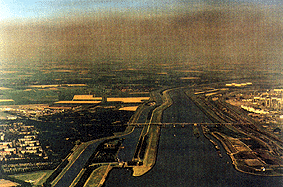
Smog above Rotterdam Harbour (Photo Geosens).Nowadays the term 'smog' refers to any excess of health damaging pollutants in the atmosphere. In The Netherlands, winter smog is characterized by an excess of sulphur dioxide, caused by purely human activities such as coal-fired power plants. Its modelling is relatively easy because only five slowly reacting chemical compounds have to be taken into account. Summer smog is characterized by an excess of ozone formed as a by-product in reaction chains originating in organic compounds produced by humans as well as in nature. Here the modelling is far more difficult: we have to include a large number of compounds reacting at widely differing speeds.
One of the improvements in the computations concerns the use of a more flexible grid. A reliable medium-range smog forecast for The Netherlands requires an area of the size of Europe to be taken into account in the model computations. With a uniform grid the use of mesh sizes below about 60 kilometres takes too much computing time. However, several phenomena relevant for smog prediction, such as pollution in urban areas caused by local emissions, can only be satisfactorily described by using smaller meshes. The method of Local Uniform Grid Refinement, which CWI already successfully applied in other cases, turned out to be ideally suited for dealing with this problem. Only in areas where 'a lot is happening' a finer mesh is used and eventually adapted at each time step.
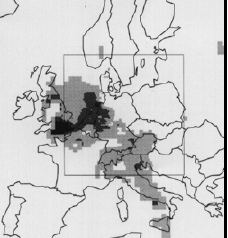
Computed ozone distribution over Europe
(24-07-89, 14:00 MET).New numerical techniques were also applied to describe the horizontal motion of chemical substances in the atmosphere. The overall result is an efficient computation method for air pollution models in aid of regional smog forecast on the European scale. The research was part of CWI's long-term multidisciplinary Mathematics & Environment programme.
Please contact:
Maarten van Loon p; CWI/Delft University of Technology
Tel: +31 20 592 4105
E-mail: vanloon@cwi.nl