ERCIM Working Group Environmental Modelling
by Achim Sydow
The modelling and simulation of complex processes in the environment is a challenge for informatics and mathematics. The increasing environmental pollution destroys the ecological balance, continuously reduces the healthy biosphere, and diseases caused by civilisation are a problem with growing importance. Thus the numerical modelling and simulation of man-made changes to the ecosystems is becoming increasing-ly important to government bodies and industries involved in environmental and health protection.
Complex multi-dimensional simulation models of environmental systems require modern high-performance computer systems being still within the budgets of small companies and local government. The quality of the numerical algorithm design - fast equation solvers - is of the same importance as the hardware. Parallel computers and parallel simu-lation software play a central role for future research in this field. There is also a need for the introduction of modern software engineering concepts, which allow the efficient use and servicing of complex simulation software packages.
The quantity of used and derived data increases steadily with the increasing complexity of the models. New concepts for the data acquisition systems are under development, eg satellite imagery, weather radar, stationary and possibly mobile observation stations. The storage of datasets requires high-performance Geographical Information Systems and Database Management Systems. These provide interfaces between the input data and the different simulation modules (pre-processing), and between the calculated results and the graphical representation (post-processing) respectively.
In order to form realistic simulation models of important environmental processes for air, water, soil, several interdependent models have to be linked together. Examples would be multi-disciplinary environmental and pollutant dispersion models for urban and industrial regions for both air and ground. Although many users are interested in such complex simulations, this type of high-performance computer model is only just beginning to be developed. Other complex simulation models can be derived from a study of the impact of changing environmental conditions on ecosystems. Current investigations show that the combined effect of several environmental impacts on human beings, plants, etc. is extremely nonlinear.
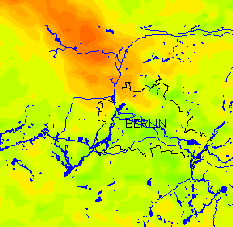
Simulated surface-near ozone concentration in the
Berlin/ Brandenburg region on 25 July 1994, 4 p.m.,
realized by the DYMOS research group at GMD,
one of the partners in the Environmental ModellingWorking Group.The actual cooperation partners of the ERCIM Working Group are:
see also: http://wwwold.first.fraunhofer.de/ercim
- GMD, Institute for Computer Systems and Software Technology, Germany - Research team Dynamic Models for Smog Analysis (DYMOS),
- INRIA, France - Research team 'Air'
- FORTH, Institute of Applied and Computational Mathematics, Greece
- Universidad Politecnica de Madrid, Spain - Group of Environmental Software and Modelling
- Universidad de Las Palmas de Gran Canaria, Spain, International Center for Research on Computer Science
Please contact:
Achim Sydow - GMD
Tel: +49 30 6392 1813
E-mail: achim.sydow@gmd.de