CardiAssist Improving Cardiac Telediagnosis by Enabling Systems and 3D Ultrasound
by Thomas Berlage
The European project CardiAssist aims at the support of cardiac diagnosis and telecooperation based on three-dimensional ultrasound images. The project integrates three developments: 'EchoSignal' improved image quality for 3D ultrasound, 'EchoVol' an enabling system to provide spatial and diagnostic orientation and 'EchoCom' 3D ultrasound images as a communication medium between cardiologists and surgeons. The system will be implemented on three industrial platforms: a new-generation ultrasound scanner, an add-on device for existing scanners and a stand-alone training platform.
Teleconsultation plays an increasingly important role in medicine. It enables physicians to verify a diagnosis together with a remote colleague without sending the patient to another examination. It provides a seamless connection between diagnosis and treatment when these are in separate locations. Teleconsultation is vital in emergency situations or in rural areas when no specialist is available.
Cardiological telediagnosis needs three-dimensional ultrasound, because 2D images depend on the transducer position during acquisition, which is difficult to control remotely. 3D image data sets provide more flexibility in asynchronous exploration of the images for efficient trans-national information exchange and remote consultation between specialized centers or peripheral hospitals.
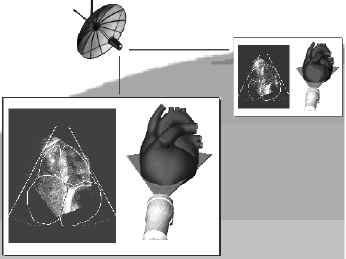
Figure: EchoCom uses patient images and models to provide visual context in communication between cardiologist and heart surgeon.EchoCom uses patient images and models to provide visual context in communication between cardiologist and heart surgeon.
A fundamental problem of current 3D ultrasound imaging technology is the high degree of expertise required to interpret the images, both because of the relatively poor image quality and because of corresponding orientation problems in the 3D data set.
CardiAssist combines the improved 3D ultrasound images with animated graphical models reflecting the location and viewing angle to provide much more intuitive image interpretation and communication.
The main result of the project will be a new diagnostic platform for cardiology to be used by medical professionals (cardiologists and surgeons) of different forms of expertise.
For the cardiologist, CardiAssist makes diagnosis faster and more accurate, because it provides a better orientation in the clinical reality dominated by time pressure and long working hours. The clinical benefits of 3D/4D echocardio-graphy are:
- better delineation of pathology through visualization of any desired imaging plane
- better description of complex anatomy by dynamic 3D displays
- more comprehensive surgical planning
- accurate quantification of volumes, function and geometry.
The CardiAssist system will also improve the communication between cardiologists and surgeons, giving the surgeon a much more detailed orientation about the patient's situation.
Finally, the CardiAssist technology will improve continuous medical education and quality assurance, because interaction with and communication through the heart model convey many forms of cardiological expertise. As the manufacturers of ultrasound imaging instruments move into more and more specialized domains, training needs increase. Embedded training and support systems reduce the support costs for these specialized devices.
The consortium, coordinated by GMD, consists of
- manufacturers of ultrasound scanners: VINGMED Sound (Norway), TomTec, SONOTRON (Germany)
- research partners: GMD, SINTEF
- medical experts and users: Pediatric Cardiology Bonn (Germany), Thorax Center Rotterdam (The Netherlands), Clinico Santa Maria Lisbon (Portugal).
The project is partially funded by the European Union in the Health Care Telematics program (HC1004). The project started in January 1996 and will be concluded in 1998 by a clinical demonstration in a number of European hospitals. More info at http://www.gmd.de/fit/projects/cardi-assist.html
Please contact:
Thomas Berlage - GMD
Tel: +49 2241 2141
E-mail: berlage@gmd.de