Web-based Medical Services in the Regional Health Care Network of Crete
by Catherine Chronaki, Xenophon Zabulis, Manolis Tsiknakis, and Stelios Orphanoudakis
During the last few years, the Center for Medical Informatics and Health Telematics Applications at the Institute of Computer Science (CMI-HTA), FORTH, is actively involved in the development of web-based services that allow medical specialists to access information related to their profession, regardless of their actual geographic location. As these web-based medical services are gradually integrated to the results of other EU and national projects, healthcare professionals will be able to collaborate with their peers, share opinions, exchange clinical data, and access regional information. Hence, continuity of care will be promoted at a regional, national, and transnational level.
In the regional network of Crete, the WWW paradigm for information access and delivery has been adopted to provide authorized users with integrated medical services through an unmodified web browser. This web-based environment, initially created for the collection and annotation of image collections will gradually integrate patient record data that will allow the discussion of medical cases and promote remote opinion request and tele-consultation. The gradual integration of patient record data will take into account data, presentation, control, and functional integration aspects. A domain specific framework for the integration of distributed patient record segments maintained by heterogeneous autonomous information systems which form the logical components of the patient record will be adapted for that purpose.
Initially, the provided medical services will include image processing, content-and annotation-based search for images and annotations, authoring of annotations and image descriptions, and user collaboration facilities. Asynchronous collaboration through e-mail, postings, and shared workspaces as well as synchronous collaboration through an on-line collaboration forum will be facilitated. Furthermore, the Image Indexing by Content network, (I2Cnet), will provide content-based access to medical image collections and related data. Consequently, health care professionals may browse through medical images and related patient data guided by different notions of image similarity, thus sharing experience and information regardless of their physical location.
Shared Workspaces
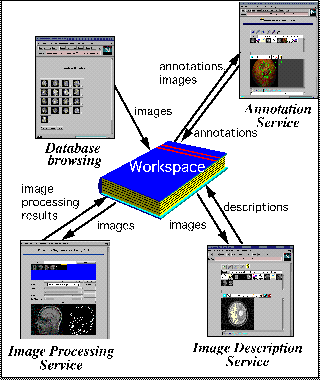
Shared workspaces support the cooperation of authorized users and service integration by providing secure and transparent access to a heterogeneous data collection anytime and anywhere browser software and a network connection are available. This data collection may include web service results and multimedia data objects (images, voice, video, patient annotations, etc.) which are inserted by the users sharing the workspace. Thus, multiple users may collaborate over a workspace, sharing material of common interest. All services have workspace access, making the transfer of data from one service to another seamless and transparent irrespective of the actual network location of the data object (see figure).
Workspaces facilitate the integration of web-based medical services
by providing transparent access to multimedia data.Image Processing Service
An extensible collection of image processing and analysis algorithms can be supported. These algorithms allow remote users to use the algorithms present at various sites to analyze images which reside anywhere on the Web. This service is based on an algorithm execution tool which facilitates the dynamic introduction of new image analysis and processing algorithms. The algorithm execution tool reads an algorithm description file and dynamically creates the Web interface of the algorithm. The algorithm execution tool employs an execution agent that handles the platform specific details of the algorithm execution, separating the client user interface from the execution platform.
Annotation Service
The objective of the annotation service is to provide healthcare professionals with the ability to interact with imagery, creating, viewing, and communicating annotations on groups of images. An annotation may include graphics and text grouped in multiple overlays and be associated with various media types such as images, text, sound, hypertext, video. The annotation service allows users to collaborate over groups of diagnostic images and related patient data. Hence, medical specialists may create annotations for their private collections, discuss them using e-mail, or use them in discussion fora and on-line collaboration sessions.
On-line Collaboration Service
The on-line collaboration service permits user interaction in pseudo-real time through the discussion of multimedia data objects ranging from electrocardiograms and diagnostic images to laboratory results. Users sharing a workspace may discuss using an on-line talk facility and comment on various workspace objects. The contents of the workspace constitute the conference material, and the user that requests the launching of the collaboration session controls the floor. In the course of an on-line session, the joint annotation of a group of images may be performed.
A regional network provides healthcare professionals with the necessary infrastructure to collaborate with their peers, share opinions, exchange clinical data, and access regional information. We believe that integrated medical services as the ones discussed here, will facilitate the interaction and active participation of a large number of users in the evolution of the information repositories in the regional healthcare network. For further information please visit http://www.ics.forth.gr/~telemed/services.html
Please contact:
Catherine Chronaki
or Manolis Tsiknakis ICS-FORTH
Tel: +30 81 391690
E-mail: {chronaki,tsiknaki}@ics.forth.gr