Simulation of Underground Gas Storage
by Hans Molenaar
Gas storage in depleted, but not empty, gas fields that are no longer in production, creates a buffer which may solve the problem of meeting peak demands in the delivery of natural gas to Dutch households and industry. The Dutch Gas Unie/NAM (Nederlandse Aardolie Maatschappij), intending to use this method, sponsors a study of the mixing of stored and initially present gas, carried out by Delft University of Technology (TUD) and CWI.
Control of the mixing is important for delivering gas of constant quality. Whereas TUD investigates the physical effects causing mixing, CWI develops an efficient, state-of-the-art numerical code for computer simulation of underground storage.
The displacement of both gas components involves convective and dispersive transport mechanisms. Convection, conventionally described by Darcy's law, does not lead to mixing. Dispersive transport is governed by diffusion and dispersion. Whereas diffusion is the result of random motion of gas molecules, the term dispersion is used to cover a variety of physical phenomena. On the field scale (typically hundreds of meters) the dominant effect is macroscopic dispersion, caused by variations in the rock properties. In simulations on this scale, the total effect of local heterogeneities is modeled through the concept of macroscopic dispersion. Enhanced mixing due to the presence of immovable water (some 20% of the total volume in typical reservoir rock) is taken into account. Contrary to this, mixing due to gas dissolution and diffusion is not described by some enhanced dispersion factor, but is explicitly modeled.
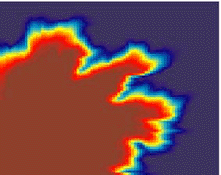
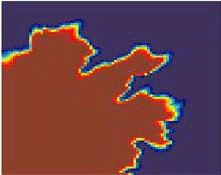
An algorithm for numerical simulation of gas mixing should be accurate and efficient. Accuracy is not trivial, as can already be seen in the simple case when there is neither diffusion nor gas dissolution. Here natural numerical schemes like the finite element method will fail because initial discontinuities persist. Although this can be remedied by taking into account the flow direction in the discretization, the resulting first-order upstream scheme still suffers from numerical diffusion, causing the solution to smear out in a completely unphysical way.
Simulated gas injection (from below left) in a highly heterogeneous permeability field without physical mixing.
Left the first-order upstream scheme, with significant mixing due to numerical diffusion.
Right the high-order accurate scheme.In the past new high-order accurate upstream schemes were developed at CWI. Because these schemes are highly non-linear, the construction of efficient and robust solvers is far from trivial. First the attention was focused on the steady-state Euler equations, for which instead of Newton's method a defect correction method was proposed. In this way a high-order accurate solution was obtained, while only solving first-order discretized problems (which turns out to be easy). Next this method, proven successful for steady-state flows in computational fluid dynamics, was applied to our time-dependent full gas storage problem. In tests using realistic field data the defect correction method turned out to be an efficient and robust solver also in this harder case.
Now this algorithm will be implemented in an easy-to-use gas reservoir simulator, to be used at TUD in further laboratory experiments and by Shell as a benchmark for numerical reservoir simulations.
Please contact:
Hans Molenaar - CWI
Tel: +31 20 592 4211
E-mail: hansmo@cwi.nl