Structuring Patient Records
by Erik van Mulligen
Renewed interest in computer-based patient records (CPR's) has stimulated research in structured data entry. Research and development of an architecture for a multi-media CPR for cardiology is the objective of the EU project Integration and Communication for the Continuity of Cardiac Care (I4C).
With structured data entry, patient data are directly encoded at data entry time (ie by the clinician) and stimulates the electronic sharing of patient records among clinicians and general practitioners. It also facilitates clinical research and the integration of online clinical information sources, so that new biomedical knowledge can be effectively retrieved and applied to patient care. For optimal health care, clinicians need to combine increasing volumes of patient data with an fast expanding biomedical knowledge base - doubling at least each 19 years - in an efficient, cost-effective, and evidence-based way. New diagnostic and therapeutic systems generate mass amounts of data in addition to extensive data collected during the clinical encounter. Last decade, researchers in medical informatics have explored approaches how to use information technology for efficient clinical data management in a computer-based patient record.
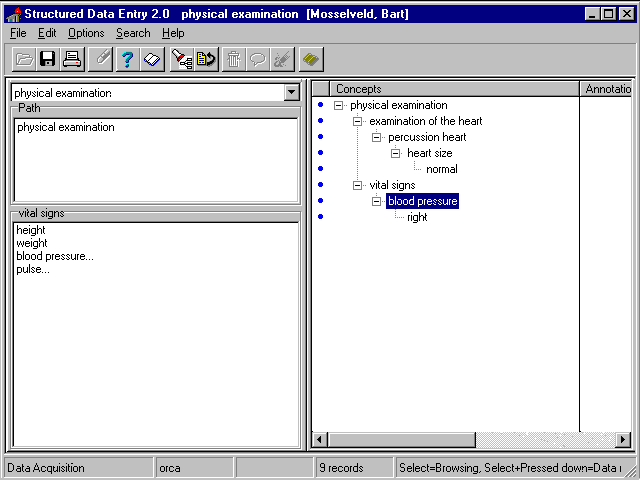
Figure: Descriptive knowledge controls the set of data items for structured data entry. The CPR allows data sharing with other clinical professionals: cardiologists, specialists, general practitioners, etc. Sharing data between professionals will eliminate costly duplication of tests and use existing data more efficiently. Having all existing data from a patient available at the clinician's desk irrespective of the place where the data are stored, the type of dataß textual, images, biosignals, or video or the collector of the data will improve clinical decision making.
Sharing data electronically between clinical professionals requires a CPR to be structured and encoded. Encoded patient records support that clinicians from different medical disciplines can have different views with different levels of granularity on the same patient record (eg, a cardiologist will describe findings about the heart in more detail than a neurologist). Since it is clear that structured data entry in a CPR is typically more elaborate than scribbling something on a sheet of paper or entering free-text data in a computer, the I4C project has strongly emphasized the user interface for structured and encoded data entry. As an essential component of the CPR, a knowledge base with descriptive knowledge has been developed that guides the clinicians during structured data entry. This descriptive knowledge base is used to visualize optional data items in their context and limit this set of data items to those that are relevant for that particular patient.
A second interest in the I4C project is retrieval of data from existing legacy systems and making them available in the multi-media CPR. The objective is to create generic interfaces to various types of information systems that exist in health care. Specific drivers for the different legacy systems can be plugged in without changing the interfaces of the CPR.
A next step in the evolution of structured CPRs will be the integration of clinical information sources; the encoded data in a CPR can be used to control the retrieval of biomedical knowledge contained in online clinical information sources (digital libraries, reference data bases, clinical decision support systems, clinical protocol servers, etc.) and inform the clinician about relevant information found in these sources. In this way, the computer can be used to effectively integrate a growing amount of biomedical knowledge with direct patient care. Introduction of the multi-media CPR at clinical test sites is foreseen in 1998 at various clinical centres in Europe. Assessment and evaluation of this CPR by clinicians will give input for further developments in this area.
The I4C project is part of the 4th Telematics Programme of the European Union (DGXIII). The Erasmus University of Rotterdam (department of medical informatics) is coordinator of this international project which terminates at the end of 1998. Five core and several clinical partners from different European countries are involved in this project.
Please contact:
Erik van Mulligen - Erasmus University Rotterdam, Dept. of Medical Informatics
Tel: +31 10 4087047
E-mail: vanmulligen@mi.fgg.eur.nl