DACCORD - Control of Motorway Networks
by Henk Nieland
The DACCORD project (1996 -1998) aims at developing and testing coordinated control measures for motorway networks. It is part of the European Union Telematics Appli-cation Programme, sector Transport. CWI contributes with theoretical research into integrated control and routing control of motorway networks.
Given increasing traffic intensities of motorway networks, with capacities remaining limited, control measures are required to keep the networks operating properly. Facilitated by the relatively low costs of communication networks and computer hardware, by now several control measures have been installed: incident management, ramp metering, speed control, dynamic routing information, variable message signs, etc. These measures were installed incrementally, but in general they interact. In an integrated approach, where all control measures serve the same objective, the possibly negative effects of this interaction are prevented.
The main objective of DACCORD - Development and Application of Co-ordinated Control of Corridors is to create a practical Dynamic Traffic Management System (DTMS) for integrated and co-ordinated control of inter-urban motorway corridors. It addresses the needs of road authorities and traffic operators responsible for (parts of) the European motorway network, as well as the drivers. The project in particular aims to increase effective road capacity, and reduce travel times and number of accidents.
An essential element is the integrated operation of control at a network-wide (ie, not local) level, using the following control measures:
- dynamic information on queue lengths, travel times and routing directions through variable message signs
- ramp metering systems for motorway access control
- motorway-to-motorway control systems (ramp metering at motorway merges)
- variable speed limits and lane closure signals
- pre-trip and en-route information by broadcasting and radio data systems.
Other issues addressed in DACCORD are:
- tests with dynamic traffic management systems at three test sites in three countries
- practical use of on-line short-term forecasting in the traffic management centres
- realizing an open system architecture for inter-urban traffic management.
DACCORD mainly builds on the CHRISTIANE, EUROCOR, DYNA and GERDIEN projects, which were parts of the EU programme DRIVE. The R&D work focusses on the optimization of the simultaneous use of multiple control instruments in order to maximize their combined effect, and to avoid unwanted side-effects. Three major test sites are used for practical validation in real life situations (in brackets the particular aspects explored):
- the Amsterdam network, part of the EuroDelta initiative (traffic state monitoring and estimation; short time prediction models for traffic flows, speeds, queue and travel time; display of estimated dynamic travel times using VMS; co-ordination and integration of ramp metering control and VMS control)
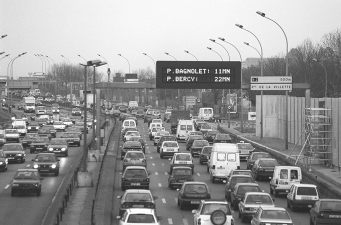
- the Paris network, including the ringroad and the connecting motorways (motorway-to-motorway control including real time ramp metering techniques; estimated travel time display on the Corridor Peripherique of Paris and the SIER motorway; real data screening)
- Padua Venice motorway, part of the Pitagora initiative (on-line traffic model system including the OD estimation and prediction).
Travel time display on the Corridor Peripherique of Paris.The twenty odd partners in the DACCORD consortium, located in eight countries, are mainly from Italy (5), France (4), and The Netherlands (8). Main contractor is Hague Consulting Group (NL), the other contractors are: Centro Studi sui Sistemi di Trasporto CSST (IT), Institut National de Recherche sur les Transport et leur Sécurité INRETS (FR), Technical University of Crete TUC (GR), TNO Institute of Applied Physics TNO-TPD (NL), and Autostrade Italia Nord-Est AINE (IT).
CWI's contribution to DACCORD consists of research on routing control and on integrated control of motorway networks. A model in the form of a control system is being developed, which incorporates the existing control measures and describes their interaction. The model is hierarchical, with three (interconnected) levels: network, link, and point. The network level is typically an urban ringway plus stretches of connecting motorways (say 50 km x 50 km), the link level a stretch of motorway between two adjacent intersections (say 10 km), and the point level could be an on-ramp of a motorway, the merge of two or more motorways, or a tunnel. New features are:
- integration of routing control and admission control at the network level, because these functions are related
- flow control is done at the link level, with estimates of intensities coming from the network level
- admission control at the link level by coordinated ramp-metering uses information from the network level.
DACCORD Project web page: http://www.hcg.nl/daccord/
Please contact:
Jan van Schuppen - CWI
Tel: +31 20 592 4085
E-mail: schuppen@cwi.nl