Research on Co-operation between Health Care Structures at ISRDS-CNR
by Fabrizio L. Ricci
The Medical Information Group at the Istituto di Studi sulla Ricerca e Documentazione Scientifica in Rome (ISRDS-CNR) has a long tradition in developing conceptual models of healthcare structures. Recent work includes the investigation of the CSCW (computer supported co-operative work) approach in modelling healthcare treatment. Our research focuses on: i) conceptual models describing clinical, managerial and communication workflows in a federation of healthcare structures (the ATREUS model); ii) conceptual models to represent the heterogeneous data of a federated patient folder (the MIC/MIE model). We are now developing CADMIO, a tool for designing patient folder management systems, based on the MIC/MIE model.
In order to contain health costs, we must minimise periods of hospitalisation and, instead, follow the patient throughout the care process within the various healthcare structures A healthcare structure should have an information-organisation system (IOS), which, on the one hand, manages its own information (management of staff, equipment, etc.) and, on the other, manages information shared with other structures (data on the patient, diagnostic and therapeutic protocols, etc.). A co-operative information system between the IOSs must be developed. The Medical Information Group at ISRDS-CNR participates in the Italian National Programme of Research in Telemedicine (1996-1999), in the project for Hospital Information Systems. This line of research has been granted approximately 11 MECU. Our partners are five national information technology industries and four hospitals. Our aim is to define a conceptual model for healthcare structure co-operation and for a federated medical folder.
A workflow model
In a healthcare structure any kind of activity, whether clinical, administrative-managerial, programming or control, must be executed according to a previously defined workplan, which can be labelled as a protocol. In order to describe the other protocols (clinical, administrative-managerial, programming and control) and their interactions inside and outside of healthcare structures, we have defined a workflow model: ATREUS. The ATREUS model is based on the description of activities in terms of sub-activities and the temporal relationships between them (ie sequential order, partial or total concurrency, etc.). For each activity, we define: pre-conditions, post-conditions and exception-handling. The model is based on a graph: activity / event diagram. The textual information associated with each node is related to the information flow: it describes the source and the receiver of the communication, the actors , the content of the message exchanged (eg medical report, diagnostic exam), the channel used, etc.
The model makes it possible to refine the description of activities according to the users' needs. Such refinements are used to obtain new protocols customised according to the patient, available resources, and the organisation's characteristics. The clinical aspect is the prevailing one at the topmost level of the hierarchy. However, the more the activities are refined, the more the management and communication aspects prevail. The most refined activities have to take into consideration the organisational details of the single healthcare structures. The end user (physician, healthcare manager, etc.) can navigate in ATREUS according to the activity flow or the information flow.
We propose a software system for planning and coordinating the activities of different healthcare structures, based on an intelligent agent architecture. Knowledge, role and competence characterise each agent and are extracted from the ATREUS conceptual description of the clinical, managerial and communication workflows. Agents and their own referents are organised in a hierarchical topology that reflects the healthcare organisation. Each organisational structure and/or person is represented by an intelligent agent. Co-operating agents have only a partial knowledge of the overall structures, roles and skills.
A Model for a Visual Information System of Patient Folders
When describing the patient status, all physicians in a federation of healthcare structures use a set of common entities. We define such a set: Local Entity Dictionary (LED). The purpose of the LED is not only to provide a simple classification of the entities that have to be managed, but also a tool to describe their logical organisation.
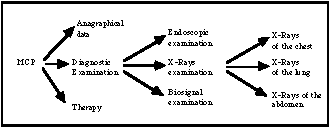
The MIC/MIE (Medical Information Category / Medical Information Elements) model allows a physician to define the LED; it adopts an object-oriented approach. The awareness of the existence of a natural hierarchical system among the entities which express the various medical concepts is at the basis of this model. The root of this hierarchy is the Medical Concept Prototype (MCP). This class represents the general aspects common to all entities of a set of patient folder data. The MCP is described by metavariables and variables (a metavariable is a variable which can only assume types as a value).
An intermediate level has been introduced between the MCP and the entities instanceable with the facts which form part of a patient folder: the metaclass, ie a class of classes (Medical Information Category=MIC). Classes are instances of metaclasses. Classes are referred to as Medical Information Elements (MIEs); they describe the medical information common to the users of a department. MIEs are directly instanceable with data about the patient. Instances are the facts describing the patient's clinical condition and history and constitute the patient folder. Figure 1 shows an example of LED definition using the MIC/MIE model.
Figure 1: An example of the Medical Information Category/
Medical Information Elements model.CADMIO Prototype for the Design of a Medical Folder
The CADMIO prototype (Computer Aided Design of Medical Information Objects) has two main features:
- definition of a patient folder model, specifying the relevant information and the structure
- dynamic management of the interface.
The current prototype can manage six different object-classes (ie alpha-numeric String; Image; Text; Value; Hypermedia; Hypertext; and Multimedia).
As an example, we show :
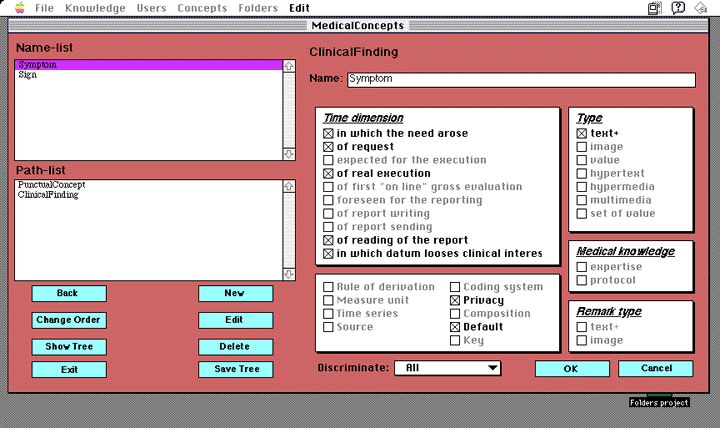
- the patient folder designer interface (Figure 2)
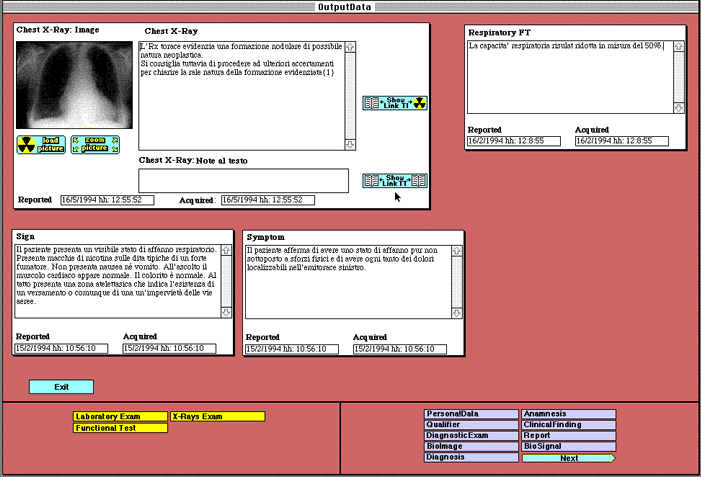
- a sample window showing the hypermedia features of the system (Figure3).
Figure 2: A patient folder interface. Figure 3: A sample window showing the hypermedia features of the system. We are proposing a hypermedia structure for diagnostic reports in radiology to facilitate exchanges between radiologist and clinician. A hypermedia radiological report software will link a region of interest (an element of a radiological image) with a comment (text or voice) and/or an elaboration of this region (for example, 3D), and/or an exemplary case and/or an image from the radiological atlas.
The CADMIO system runs on the Macintosh platform and has been developed using the Prograph® programming environment.
Please contact:
Fabrizio L. Ricci - ISRDS-CNR
Tel: +39 6 44879229
E-mail: ricci@iasi.rm.cnr.it