Open Electronic Trading System
by Aarno Lehtola, Tor Lillqvist, Kari Kekki and Seija Hakkarainen
Computerised trading systems range from simple consumer oriented shopping systems to ones implementing complicated multiphase negotiation protocols for business-to-business commerce. The Open Electronic Trading (OET) system addresses the needs of the latter category combining workflow techniques to inter-organisational EDIFACT messaging.
The OET system is developed for European wide public procurement markets rising annually to 800 billion ECUs with 10 million buyer and 16 million provider organisation units. Currently, trading involves an enormous amount of administrative work, and order handling costs are estimated to be 5 to 10 % of the overall expenses. The OET system computerises trading processes and helps in saving in the handling costs. It is based on open standards and supports multiple operating environments. Multilinguality is one of its features. The OET system is being developed by Tieto Group and VTT Information Technology in the TAPPE project of the EC.
The area of public procurement in Europe is today still suffering from minimal international competition, inadequate administrative systems for users, inadequate availability and use of product specifications, and minimal use of information and communication technology at regional, national and European level.
The aim of the TAPPE project (project AD1015 of the Telematics Applications Programme of the EC) is to support the building of a common European infrastructure for public procurement by introducing software solutions to exchange all the needed information electronically between the co-operating business partners, to make the purchasing procedures more streamlined, to open the markets over regional and national borders, and to constrain user organisations to follow agreed rules and regulations.
The results of TAPPE will cover all the main phases of the total procurement process. It will produce the following software and telecommunication applications:
- decision support tool to help users manage procurement regulations and procedures
- decision support tool to evaluate suppliers and bids
- data interchange application for announcing and tendering
- computerised contract handling system
- open electronic trading system
- application to manage and monitor procurement related work flow processes.
Tieto Group and VTT Information Technology are developing Open Electronic Trading (OET) system as a part of the TAPPE project. It handles the different stages within a given trade transaction in a situation where the seller and the buyer already have identified each other, and have a common, contract based business relationship. The main technical features of the OET system are outlined in the following.
Architecture
Within organisational boundaries the OET system applies the intranet paradigm and the HTTP protocol providing user interfaces via standard WWW browsers to the server programs (see Figure 1). Interorganisational communication of the seller's and buyer's workflows is realised using EDIFACT messages UNTDID Version D93.A for electronic commerce. Detailed message definitions are provided for the system using the DIRDEF message description format of the UN. Data communication can use existing protocols like FTP, SSH, SMTP, or X.400. Usage of the system within intranets is protected from the outside world by the organisation's firewall. Interorganisational messages are protected using, for example, the PGP program. Most of the parts of the OET system have been implemented using Java language in order to maximise its portability.
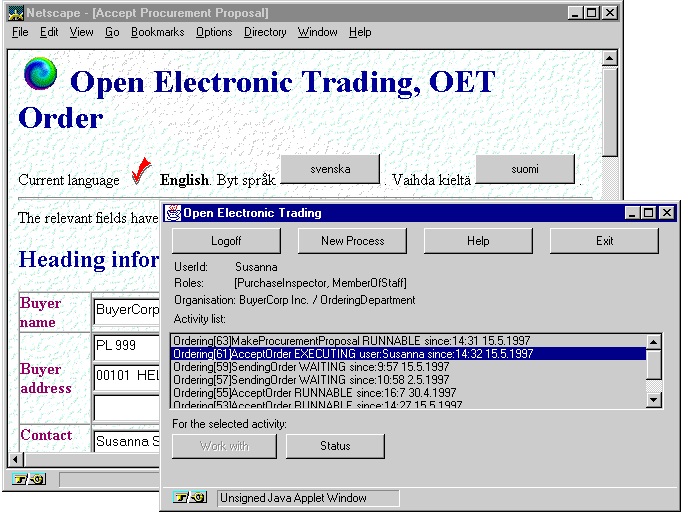
Figure 1: The workflow control interface and one of the electronic forms of the trading system.
From the user point of view, the central component of the system is the workflow control tool, which maintains action lists for users. Actions often involve handling of some electronic form. The user may also browse status records and logs of those workflow process instances where he is participating. The system guides the user to access the right WWW form and controls that the user input fulfils the integrity constraints defined for the form. The forms offered by the system are specially designed for the different roles of the users in the administrative processes. The forms are the basic interfaces via which an end user participates in trading processes.
For the used trading EDIFACT messages we have designed WWW forms. Extra functionality has been programmed in the forms using Java language. For instance, database access can be easily added into the forms using Java, and ODBC or JDBC interfaces. The program architecture within the electronic forms supports multilinguality.
Workflows
The basic idea behind workflow systems is that an organisation can be seen to perform information handling processes. Each instance of a process of a certain type is by structure identical or quite similar to another instance (eg an order handling process). The second, and newer idea behind a workflow system, is that the process types are described in a form which enables process automation and control. The third important idea is that the information to be handled during the process can be combined into the computerised process instances (eg electronic forms). The fourth important idea behind a workflow system is that such a system can be used for coordination of the work in a decentralised organisation (ie system glue).
A workflow specification or definition is the representation of the type of the process, consisting of activities (tasks, steps) and their relationships (dependen-cies such as transitions), along the data types handled by the process.
The main task of the workflow management facilities of the OET system is to ensure smooth flow of business transactions throughout the system, to guarantee the security of the flows, and control and audit the transactions. The workflows are defined following the current draft version of the Workflow Process Definition Language (WPDL) specified by the Workflow Management Coalition (WfMC). The workflow process definitions directly control the functioning of the management system. It controls, for instance, that the trading system does not either generate or accept unauthorised, faulty, duplicated, or runaway transactions. It also monitors and controls the trading processes and their state changes, stores data and communication logs, and manages user authorities.
The OET System supposes that both the buyer and the seller organisation have their own workflow processes running in their own systems, and these workflows intercommunicate using EDIFACT trading messages. Another choice would have been to build a centralised trading system, eg some kind of broker service run by a trusted third party, where the parties would log on. However, our distributed approach emphasises the independence of the parties and guarantees maximal data security. Moreover, the parties have full freedom to engineer their internal decision making processes as they wish, and to connect easily their existing legacy systems to the processes (eg stock inventory systems, invoicing systems).
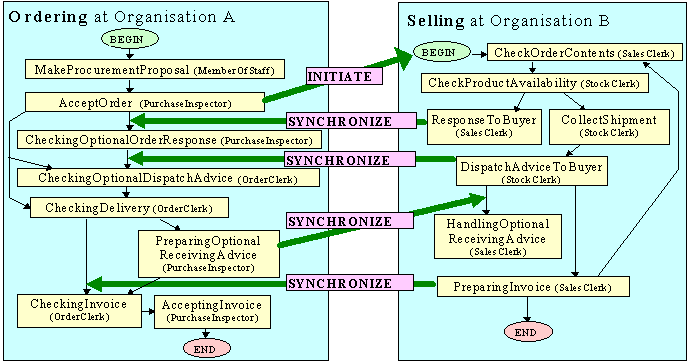
Figure 2 illustrates basic versions of intercommunicating buyer's and seller's trading processes. The two large boxes depict processes and the small boxes activities in the processes. Activities have been named and assigned user roles. Each process has a starting point and an ending point. The arrows denote possible control flow. The instances of the processes are mutually control autonomous with the exception of the EDIFACT communication links that couple the processes together. These have been marked with broad lines and the words INITIATE or SYNCHRONIZE.
Figure 2. Intercommunicating workflow processes of trading parties.
Future Directions
The mainstream of current trading systems have been implementing simple shopping scenarios. In the WWW, consumer oriented systems are common for selling information or mail order goods. This orientation is natural as the used technology is cheap and the investment pays back quickly. On the other hand, systems that assist inter-organisational electronic trading processes are more rare. This form of trade is characterised by long-living transactions, high security requirements, multiphase protocols, involvement of many actors in the process, and embedding of various legacy systems in the total process. These systems are much more complex than shopping systems. However, the potential to savings is also huge. In public procurement field, order handling costs are estimated to be 5 to 10 % of the overall expenses. It has been estimated that by replacing the manually executed administrative processes with computerised ones up to 90% savings could be reached.
The decision to apply the intranet paradigm, open EDI standards, and workflow techniques in the OET system has proved to be good. The inter-organisational interfaces are made fully generic, in contrast to traditional EDIFACT systems that usually have been tailored for certain bilateral usage, or have been industry field specific.
Nowadays, trade transactions frequently cross language borders. While ever larger number of users get connected to electronic trading processes, it is no longer possible to presume that everyone knows eg English language. Support for local language is becoming increasingly important in the trading systems. The OET system has been designed from the beginning to be multilingual. Now there are three languages involved: English, Finnish, and Swedish. We are looking forward to enlarge the language coverage to most European languages.
Please contact:
Aarno Lehtola - VTT Information Technology
Tel: +358 9 456 6032
E-mail: Aarno.Lehtola@vtt.fiKari Kekki - Tieto Group
Tel: +358 9 526 2274
E-mail: Kari.Kekki@tietogroup.com