TEN-34 - Implementing the Network
by Michael H. Behringer
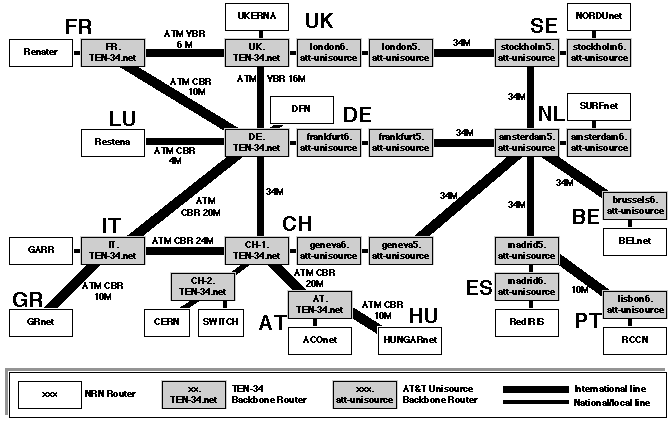
For the first time in Europe, the TEN-34 project has provided a pan- European high-speed network for European researchers. To achieve this it was necessary to integrate diverse technologies such as conventional leased lines and ATM circuits. Due to the lack of available technical options the implementation had to work around many non-technical obstacles. The outcome, however, is a smooth and transparent IP service.When the planning for the TEN-34 network started in 1995, the technical options for high-speed international connectivity were limited: the telecom operators for a number of countries did not offer 34 Mbit/s lines, some only offered these and no ATM. Thus a hybrid solution of leased lines and ATM circuits was inevitable to achieve full European coverage. The challenge from the technical point of view was to get international ATM circuits operational which was new ground for telecom operators at the time - and to integrate these with traditional leased lines. From the beginning, it was obvious that the network would consist of two parts: a mainly ATM based part between France, the UK, Germany and Italy (called FUDI), and a 34 Mbit/s leased line network between the Netherlands, Sweden, the UK, Germany, Switzerland and Spain (Unisource). Other countries are connected as shown in the figure.
The TEN-34 Topology.The Unisource side consists of a network based on 34 Mbit/s leased lines. The service is managed on the IP level by Unisource. A migration of the core network to a full mesh of ATM circuits is being carried out at the moment. Unisource provides a full IP service, to which commercial customers also connect, and which provides connectivity to other European networks such as Ebone.
On the FUDI side the telecom operators provide mostly ATM circuits, and one 34 Mbit/s leased line. The ATM services in use are continuous bit rate (CBR) and variable bit rate (VBR). The choice between the two was mainly based on price. As only circuits and no IP services are provided, TEN-34 provides routers to interconnect these, and to provide an IP service over the infrastructure. The TEN-34 routers also interconnect the two sub-networks in the UK, Germany and Switzerland. A Network Operations Centre (NOC) for TEN-34 was established in London.
The national research networks (NRNs) have a uniform interface towards TEN-34 on both sub-networks. Speed limitation to a specified bandwidth was established on the access lines with ATM to ensure balance between the NRNs. Overall, the NRNs are presented on their access point with a transparent IP service, which hides the different implementation details.
Connectivity to the US is currently implemented independently from TEN-34 in most countries, but a 34 Mbit/s line from Frankfurt is planned for those countries that do not have their own US line. On the US side it will connect to two European points of presence (PoPs), and from there connections to various US networks will be established. The line to the US will be implemented as a clear 34 Mbit/s line without ATM. The line between the two European routers in the US will be a clear 45 Mbit/s.
One technical problem with IP networks of this size is the provision of traffic statistics. Routers are generally not able to use traditional accounting methods that do not involve additional hardware. However, new accounting methods have been developed recently. On the TEN-34 network, accounting will be based on so-called 'net flow' statistics, which require a workstation close to the router, so that the vast amount of accounting data can be processed there. The workstations needed for this are currently being procured across Europe. From these data the NOC will provide statistical information for network planning and usage reports.
Originally it was also planned to provide direct access via ATM to the NRNs, so that NRNs can establish virtual private internetworks. This would involve ATM switches being deployed in all participating TEN-34 PoPs to make use of this service. Given the short lifetime of the TEN-34 network (up till July 1998), it is currently unclear whether the additional expenses for the switches will indeed be incurred.
The first parts of TEN-34 became operational in March 1997. The first four months presented a smooth IP service with few problems, despite the introduction of new technologies and the diversity of technologies employed. There were a number of line faults on both the ATM parts and the leased lines but, as the majority of the network is designed to be resilient, users did not notice major outages. The traffic has been increasing significantly since the beginning, but the network is still not loaded. For the first time in Europe, TEN-34 has shown that ATM circuits and leased lines can co-exist in a IP network and that the resulting service can be presented to the users as a uniform network.
DANTE, UK, is coordinating partner in the TEN-34 Consortium.: For further information, see: http://www.dante.net/ten-34
Please contact:
Michael Behringer - DANTE
Tel: +44 1223 302992
E-mail: Michael.Behringer@dante.org.uk