 ERCIM News No.31 - October 1997
Over the last few years we have experienced a growth in information and communication technology which few would have dreamt of just four or five years ago.
The commercial and mass popular uptake of the Internet is the catalyst; the merging of information and communication technology a precondition. World Wide Web, interactive TV, electronic commerce, virtual reality are some of the hyped buzz-words; while human resources are the real bottleneck.
In several respects the situation is emergent as in the early 1970s: the use of information and communication technology is spreading into new areas where no one paradigm is the obvious choice, fact and fiction are difficult to differentiate, and public education lags behind.
In this situation, where most people seem to think that products have to come from Microsoft to be worth buying, and ideas from MIT's Medialab to be worth buying into, European IT-industry and research are fighting an uphill battle. There is no silver bullet, but ERCIM can provide some useful ammunition in the form of informal, dynamic structures and processes which can strengthen our ability to act quickly, develop and try out promising ideas when they are new and not when a formal proposal is accepted.
ERCIM already has a rapidly growing membership of public research organisations and through working groups connections to private companies are being established. Thus ERCIM offers important opportunities for building personal networks that connect research, industry and the rest of society. Networks that give better faster communication and which create the informal frameworks for new initiatives with and without the direct participation of ERCIM.
Secondly, ERCIM can play an important role in developing the 'EU inner labour market' of information and communication technology, with a focus on research and PhD studies. The existing fellowship programme is an important element of this, but it can, and should, be supplemented by a less formal means of matching the interests of people with opportunities across borders.
Thirdly, ERCIM could play a role in creating a broad spectrum of pilots and experiments in broadband networking. This issue presents a special section on Research Networking in Europe. Hopefully it will show exciting new opportunities, not only for research cooperation, but for all kinds of structures across borders, international as well as private/public.
Finally, we should reinterpret the 'I' in ERCIM to stand for both Informatics and Interaction, and the 'M' for both 'Mathematics' and 'Media'. The IT scene is rapidly changing and the technical/rational approach is no longer credible on its own. To revitalise European IT we need new forms of cooperation merging traditional technical, scientific approaches with the humanities, aesthetics, art and design.
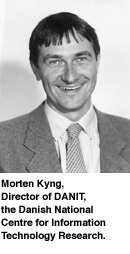
Morten Kyng