Visual Enabling for Precision Surgery
by Friedrich Gebhardt
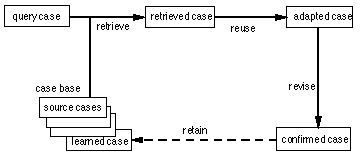
Human beings act very efficiently by utilizing previous experiences or cases. Cased-based reasoning (CBR) attempts to transfer this procedure to the computer. Project FABEL (1992-1996) has brought many new insights into this field. A recently published book develops a systematic view on complex cases and their treatment.The figure shows a schematic view on CBR as it works fine with simple cases. But what if the cases have a rather complex structure? The utility of a source case is known only after using it; therefore one has to work with its similarity to the query case instead. The definition and investigation of useful similarity functions for complex cases is the first problem area of CBR.
The query case is extracted from user's current problem. One or more cases that fit it best are extracted from the case base and reused with automatic or user-guided adaptations. If necessary, the adapted case is revised outside the CBR system. The confirmed case may be added to the case base.Adaptation may use a domain theory, tools or just heuristics. Several cases may be needed, possibly interacting in a complex manner. Guiding the reuse is the second problem area. The main results of FABEL, a joint project of GMD with five other German partners, are a prototype with the application area design of buildings with complex installations, about a hundred publications, and finally a book by four GMD authors on reasoning with complex cases. The book includes not only FABEL insights but also a systematic overview on the state of the art.
FABEL on the web: http://www-fit-ki.gmd.de/projects/fabel/fabel.html
Please contact:
Friedrich Gebhardt - GMD
Tel: +49 2241 14 2660
E-mail: friedrich.gebhardt@gmd.deAngi Voß - GMD
Tel: +49 2241 14 2726
E-mail: angi.voss@gmd.de