The Danish Research Network is going Wireless
by Allan Jensen
The Danish Research Network is being extended and upgraded dramatically at present. As a result of the liberalisation of telecommunication services in Denmark, alternative wireless solutions are now a serious competitor to traditional data communication services based on physical media. By using wireless technologies on selected positions you gain savings in cost by orders of magnitude.The National Research Network in Denmark, which has run since 1987 and is known as DENet, is being radically renewed. The Danish Ministry of Research and Information Technology is providing funds equalling 15,000,000 ECU to make significant changes to the network.
The new Research Network will like its predecessor use Internet technologies and will be an integrated part of the global Research Network and the Internet. But it will offer higher transmission speeds, new services and extend the range of connected institutions.
Around 100 research or research related institutions have been offered connection to the network and more than 95 are already connected. In this way, the network has evolved from being a tool for the academic world to covering the whole research sector in Denmark.
Furthermore, many of the 'old' DENet institutions have been upgraded. Though increased demand for bandwidth is a never ending story in the Research sector (and on Internet), it is expected that the 34 Mbit/s, to which the most demanding institutions have been upgraded, will support needs for some time.
New Opportunities as a Result of the Liberalisation
The telecommunications area was fully liberalised in Denmark in 1996 and this has introduced some new exciting opportunities with respect to the acquisition of high speed connections. Microwave technology is now available to everybody and the benefits are obvious:
- the payback time is often less than one year! And after that year it is almost free.
- The investment is reusable and mobile. For relocation you simply take down the microwave link equipment and take it with you. You do not have to pay large sums to relocate or buy new communication services from a telecommunications operator.
- The technology is said to have at least the same uptime as physical media. This project has so far no statistical experience to prove this assertion.
- The delivery time from hardware vendors is normally less than obtaining services from telecommunications operators.
This might sound like a wonderful dream for every net builder, but there are also some disadvantages:
- The operation of a microwave link demands line of sight between the antennas. Therefore you need access to elevated positions like roofs on tall buildings and masts. As the technology gets more popular, you will see good antenna positions becoming a scarce resource. This might mean that pricing of positions can make it less competitive than wires in the long run.
- Frequencies for transmission are a scarce and regulated resource, and you have to apply for these to the public authorities. In particular, demanding needs like very high bandwidths (more than 34 Mbit/s) or long distances (more than 30 km) or some combination require special frequencies which are very scarce and therefore hard to get.
- Heavy snow or rain can influence performance. The error rate goes up in bad weather although in normal bad weather you will not notice any difference in throughput. In extreme conditions, the link's performance will decrease but very seldom fall out.
- Suddenly you have become your own telecommunications operator. This means you cannot complain about a faulty link. You have to fix it yourself or buy a service contract.
The Economical Aspect
What are the economical benefits then? Of course the size of the advantage is dependent on pricing of microwave links compared to leased fibres or other competitive services like ATM. The technology is therefore most attractive in countries with significantly high tariffs on high speed communication services.
A 34 Mbit/s high speed transmission link typically costs the equivalent of 60 - 90,000 ECUper year depending on distance and quality parameters. For the same amount of money you can buy a complete 34 Mbit/s microwave link and get it up and running. This means the payback time is a year or less!
Microwaves to the Research Network
For these reasons the Danish Research Network has decided to use microwaves at selected positions. The project is in the middle of installing antennas and at the end of August this year the network was configured with seven 34 Mbit/s links to selected positions - so called distribution points from where the network will branch out to the institutions' access points. The Research Network will get its international connectivity via a 155 Mbit/s micro wave link to Sweden. These links are run by NORDUnet which offers international connectivity to the Nordic countries.
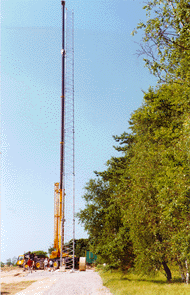
Raising a 45 m tall mast for microwave antennas.The survey's conclusion is that you should always consider microwave links as an option, when you need high speed capacity. Very often the geography is the decisive factor: can you get line of sight or not? And is the distance reasonable - say less than 50-70 km? You should then compare the investment's payback time to the price for a competitive leased service.
Please contact:
Allan Jensen Fischer & Lorenz and Danish Ministry of Research and Information Technology
Tel: +45 3392 9926 or +45 3945 0747
E-mail: aje@fsk.dk or aje@fl.dk