Hungarnet - The Hungarian Academic Computer Network
by Balázs Martos
Hungarnet provides central information services and maintains a country-wide computer network for the academic community in Hungary. There are about 42000 Internet hosts registered in the country, more than a hundred thousand people (about 80% of the Internet users in Hungary) are users of the HBONE, a wide area national Internet backbone for member organizations of the Hungarnet Association.Short History
The Hungarian Academic Computer Network dates back to 1988 when a private X.25 network was deployed to let researchers send e-mails and files to each other. In 1990, the restrictions against our country were lifted and the international e-mail connectivity was introduced. At the beginning, Hungarnet services were provided on OSI technology. In 1992, the first TCP/IP connection was set up to NSFnet accessing University of Linz via a 9.6k leased line link from Budapest.
Since then there have been significant developments. Among other things, the concept of regional centres was introduced in the national network. A regional centre is a point of presence of the academic network in a geographical region - a centre of networking and networking services for the user organizations of that area. In 1992, the development of a country-wide Internet backbone (HBONE) was initiated by the bodies funding Hungarnet. This was built up step by step, connecting the regional centres with the core of the network in Budapest and providing international connectivity for the national network. Today, there are about twenty-five regional centres all around the country, Internet is available for about 500 academic organizations having approximately 35000 hosts registered.
Organizational Background
The development of the Hungarian Academic Computer Network has been financed and coordinated by a governmental programme: the National Information Infrastructure Development Programme. For this purpose, the sponsors of the project - the Hungarian Academy of Sciences, the Ministry of Culture and Education, the National Committee of Technological Development and the Hungarian Scientific Research Fund - allocate a considerable amount of financial resources year-by-year. The annual value of cost per user is more or less equal to the cost of either one technical book per year, or one intercontinental phone call of one or two minutes a week.
Hungarnet is both the name of an association of the users of the Hungarian academic network (organizations for education, research, development, public libraries and public collections etc.) and the network itself.
The Computer Networks and Services Division at SZTAKI provides the professional expertise for the development and operation of the academic network. This division maintains and supervises the central information
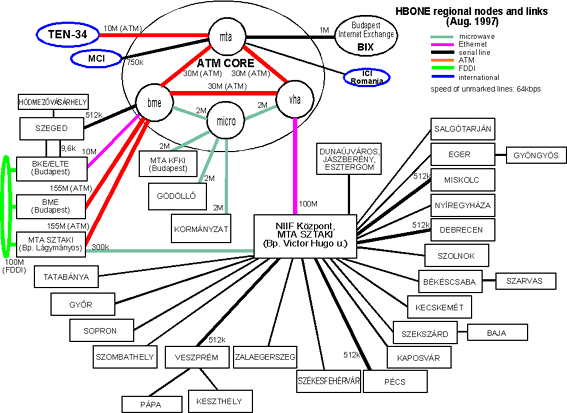
HBONE regional nodes and links.services and the country-wide network of Hungarnet. This include leading development projects, setting up and studying pilot systems, coordinating national and international networking activities, helping and training users, releasing relevant technical information, providing consulting services.
Network Infrastructure
Using a complex communication infrastructure, Hungarnet provides access to Internet and several other national information services. Access is based mainly on leased lines, but the public packet switched data network (X.25), the public ISDN network and the public switched telephone network are also used to connect different kind of users.
The backbone of the network is based on the community's private TCP/IP network, the HBONE. The core of the HBONE infrastructure is in Budapest where high speed links based on very different kind of data transmission technologies (ATM, FDDI, fibre based point-to-point Ethernet, microwave and leased line) are used according to the different, locally available services and the most cost effective solutions.
Hungarnet is a member of the TEN-34 project, the most important international connection providing a 10 Mbps bandwidth. Unfortunately, TEN-34 does not provide transatlantic connectivity for the time being. To have the transatlantic connectivity and some backup there is another link directly to the US at a speed of 750 kbps (provider: MCI).
Plans for the Future
Similarly to most academic networks, we too have a permanent shortage in backbone bandwidth. The most important task (which is more of a financial than of a technical nature) is to increase the capacity of the country-wide backbone. ATM technology is planned to be introduced between Budapest and the major regions in the country providing bandwidth in the order of 10 Mbps magnitude. Developments are expected to result in high quality Internet access, introducing wide area multimedia applications, piloting teleworking and establishing 'intelligent cities'.
More information at: http://www.hungarnet.hu
Please contact:
Balázs Martos - SZTAKI
Tel: +36 1 1497532
E-mail: martos@sztaki.hu