Trans-European Research Application Domains
by Hermann Ludwig Moeller
Numerous domains of research require a diversity of advanced networking services and serve heterogeneous user communities across Europe and internationally. At present, European research networking is largely limited to support all these domains and users through the same best effort, general connectivity service, focused on a dynamically shared interconnection of National Research Networks (NRN) and European backbone networks for research.Recent technical progress may soon allow the management of international research networks directly between selected communities and co-operating organizations, with the quality of service (QoS) as required by an application and between identified locations. Virtual Application-Domain Research Infra-structures (VRI) may benefit from directly accessing to, and interconnecting through networking infrastructure provided through a common European-level framework guiding the provision of European research networking services. A direct representation of application domains in such a framework is considered essential for achieving better economy of scale and for improving synergy on the application level.
In the following the challenge is illustrated on the basis of the example of applications in the space sector and earth observation in particular.
With the uptake of the Internet and the WWW in the early 90's, a first set of networked applications, primarily characterized by their generic nature and wide-spread use across different communities (eg e-mail, WWW-publishing) made significant advances in Europe. This evolution has been possible despite a best-effort network infrastructure with basically no management of end-to-end service, and despite infrastructures being provided through multiple, often independent networking initiatives. It has however seen the first proliferation of application domains, eg in the Telematics Applications Programme of the EC.
Advanced networking infrastructures will remain the essential pre-requisite and enabler of new Telematics applications, and with the next generation of Internet already in progress in the US, more sophisticated applications will emerge, even more targeted to specific user communities and application domains. It is a European challenge to not only ensure the continued evolution of its research networking infrastructure, but to also establish a closer link between applications serving European missions, their users and the research networking initiatives.
Research Network Applications: the Space Sector
Research network applications related to the Space sector may help in illustrating the challenge of linking applications to networking initiatives. They relate to a number of domains such as:
- collaborative spacecraft design & simulation
- earth science applications, eg observations regarding global climate change
- astrophysics, eg operation of space telescopes in remote locations
- telemedicine, eg distant care delivery in space
- space exploration, eg remote visualization for command & control of robots and experiments.
Their geographical reach is inherently multinational, trans-European, or global in nature. Users include the several thousands of European companies active in the space sector, research institutes and universities, the general public and governmental agencies, the Space Agencies of Europe and their International Partners, intergovernmental agencies and the EC.
The various space application domains differ in their networking requirements. Spacecraft design & simulation will typically take place between a smaller number of changing industrial partners in 'virtual enterprises'. Remote utilisation of space telescopes will usually be based on scheduled low-delay connections of different research establishments always with the same remote location. The situation is similar for scheduled remote experiments in 'virtual laboratories', eg on the future International Space Station. Telemedicine may have the additional requirement of guaranteed service on demand in emergency situations. In all cases, advanced networking may be required between a limited number of locations, eg involving 3D display, Real-Time Multimedia, together with public access to research results.
At present, space telematics applications are characterised by a sometimes limited use of and rather hetero-geneous approach to research networking infrastructures on the European and inter-national level.
Earth Observation
Earth Observation Applications may have the highest level of requirements in terms of networked distribu-tion. They can involve three levels of inter-networking, regarding the:
- data segments of the space agencies and satellite operators, interfacing the space-craft acquisitions to Processing and Archiving Centres
- segments related to Value Adding Companies (VAC) and scientific institutions, based on vertical, application specific structures
- user access networking including the general public.
The European Space Agency and other organisations in Europe and worldwide have engaged in the development of significant Earth Observation Data and Information Systems for data exploitation in support to scientific utilisation and future commercial applications. In Europe, these infrastructures involve facilities for acquisition, archiving and processing of satellite data and user services facilities, eg in Germany, UK, France, Sweden, Spain, Italy, and extending to Canada. Systems are capable of:
- handling interfaces to individual remote sensing satellite instruments, some delivering up to 100Mbps data streams of new data, and
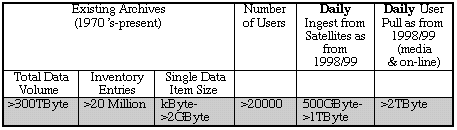
- providing access to millions of already archived data items amounting to hundreds of TBytes.
They interoperate with other such system infrastructures associated with an increasing number of international satellite missions exchanging data globally, thereby creating one of the world's largest Digital Libraries. Internetworking is provided through a combination of public networks, access to NRNs Internet, ESINet (the ESA Intranet), partners' Internet/Intranet implementations, eg NASA's Science Internet (NSI), and commercial Intranet solutions offered by Internet Service Providers and Telecom Operators.
Earth Observation Digital Libraries - Estimates - Worldwide.The internetworking of data centres and scientific institutions, upstream towards the satellite operator systems and downstream towards end-users, poses another significant challenge to networking and differs significantly between applications. Applications can be regional, eg flood monitoring in natural hazards management, multinational, eg oilslick detection in the Mediterranean, or global, eg climate change research. Requirements evolve beyond data discovery to on-line retrieval and delivery of high volume data.
At present much of this internetworking still relies on the public Internet, with its current capabilities and level of saturation effectively stopping further evolution of networked applications.
Future Outlook
Technical advances in the management of network services may form the basis for a new European-level framework, guiding the provision of research network infrastructure in support to VRIs. For the first time it may be possible to provide more tailored services to identified research application domains, locations and user communities. A common framework for:
- an Intranet for European research, allowing individual research institutions in Europe to establish their internal networks and related external interfaces, and
- an Extranet for European research, allowing the controlled internetworking of federations of data centres and scientific facilities may lead to new economies of scale on network level, eg ECU/bps and improved synergy on application level, eg improved outreach and faster establishment of best practice.
The EC may take advantage of its ongoing preparations for the 5th Framework Programme and its current activities to ensure advanced European research network infrastructures beyond the TEN-34 initiative and prepare for a more effective European-level network based research in leading application domains. Fragmentation into multiple network infrastructure initiatives should be avoided, and application level programmes should be more closely linked to a supporting network infrastructure framework, eg through the participation of advanced European user groups, leading projects and organisations representing critical European missions.
Useful URLs
US Next Generation Internet Implementation Plan: http://www.ccic.gov/ngi/implementation-Jul97/
ESA Mission Support Networks:
http://www.esoc.esa.de:80/external/mso/misnet.htmlESA's and NASA's Earth Observation User Information System:
http://earthnet.esrin.esa.it
http://eos.nasa.gov/imswelcomeEuropean and US Earth Observation Application Systems Prototypes:
http://aisws22.jrc.it
http://ceosr.gmu.edu/vdadc2.html
http://rsd.gsfc.nasa.gov/rsd/IISS.htmlThe Internation Committe on Earth Observations Satellites (CEOS) CEOSNet:
http://nic.nasa.gov/ceos-nsPlease contact:
Hermann Ludwig Moeller - ESA
Tel: +1 301614 5573
E-mail: lmoeller@eos.nasa.gov