Business Motivations for Software Process Improvement
by Miklós Biró and Tibor Remzsö
In the framework of the PICO (Process Improvement Combined apprOach) project, performed by several European companies under the LEONARDO vocational training programme of the European Union, an approach was developed at SZTAKI for bridging the existing gap between the software engineers' view and the business managers' view of software process improvement (SPI).
The fact that engineers and business managers have different motivations is well-known. To avoid the possible conflicts, it is of strategic importance to explain the differences in motivations to both sides. Managers with financial, operating, production, marketing, human behavioural, or other orientations will give a variety of answers to the question: How can I make my firm succeed where another fails? In the following, we analyse the ways how software process improvement can provide leverage to a firm from the financial, operating, production, marketing, and human behavioural perspectives by outlining a framework integrating and structuring several orientations. The key concept of our approach is the notion of lever. Levers are means used by a firm to increase its resource generating ability. Resources are used to increase the assets of the firm and reward employees and stockholders.
Financial leverage
Financial leverage means borrowing funds and investing them with a return higher than the cost of the debt. If the ROI (return on investment) for software process improvement is high enough, then it clearly provides financial leverage to the firm. We mention a few determining numbers which allow the reader to form an idea about the magnitude of the leverage that can be achieved. ROI is considered as the bottom-line figure of most interest to many practitioners and managers in a report of the SEI (Software Engineering Institute at Carnegie Mellon University, USA). The range of the ratio of measured benefits to measured costs is between 4x and 8.8x over periods of software process improvement ranging from 3.5 to 6 years. Benefits include savings from productivity gains and fewer defects, but do not include the value of enhanced competitive position which will be examined below under the title marketing leverage. Costs include the cost of a Software Engineering Process Group (SEPG), assessments, and training, but do not include indirect costs such as incidental staff time to put new procedures into place. Further results are reported in the PICO book.
Operating Leverage
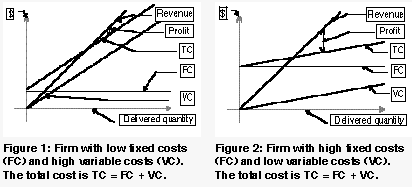
The profitability of a firm highly depends on its cost structure, that is the repartition between its fixed costs and variable costs. Operating leverage means the relative change in profit induced by a relative change in volume, which is clearly higher for a firm with lower variable costs. Nevertheless, the achievement of a low variable cost production usually presumes high fixed costs, that is a capital intensive process. Software process improvement clearly means an increase in fixed costs. The question is whether the company is able to use it for decreasing its variable costs. Measuring the variable costs of software production is not a straightforward issue. The notion of function point had to be invented to resolve this problem among others. We refer the reader to the PICO book regarding this issue.
Instead of the change in variable costs, statistical results are usually presented in terms of development productivity whose increase is in fact equivalent to the decrease of the variable cost of software production. Productivity gains per year measured in lines of code (LOC) per unit of time are reported by SEI to be between 9% and 67% at the examined organizations. Other interesting productivity statistics originating from SEI, Siemens and IBM Europe are mentioned in the PICO book.
Production Leverage
Production leverage is the rate of growth of profits resulting from cost declines due to the accumulation of production. It is an empirical fact that unit production costs decline exponentially when experiences are accumulated and the steady reuse of these experiences is well managed by the firm. The graph of the unit costs in function of the cumulative quantity produced is called the experience curve. The existence of the exponentially decreasing experience curve is due to economies of scale, learning, improvements, and reuse.
The accumulation of experiences and the management of their steady reuse is clearly one of the primary objectives of software process improvement. Interestingly, this aspect of software process improvement has not been analysed directly in the literature.
Marketing Leverage
Marketing leverage means the effect of higher prices and innovative distribution on profits. Software process improvement, maturity achievement, ISO 9000, or TickIT certification have an important impact on the perceived capability of the company and on the perceived value of its products, which contributes to improved customer satisfaction and makes it possible to achieve higher prices.
Quality and process improvement are part of a differentiation strategy in which the business delivers and is perceived to deliver a product or service superior to that of competitors. The PICO book refers to several statistics and opinions in this respect including that of Siemens according to which the promotion of the external visibility of Siemens software competence is listed as an important area to focus on and highly-predictable quality regarding system releases and costs led to greater market acceptance.
Human Leverage
Human leverage means the effect of employee motivation on profits. It is widely known that employee motivation (empowerment) can be significantly influenced by immaterial means like management styles and organizational structures. Huge individual energies can be released for example in an appropriate teamwork environment where team members are simply given the responsibility to do their jobs as well as they can, instead of exerting close surveillance over them. Among other statistics presented in the PICO book, there is a study initiated by IBM Europe, which gives a measurement of the impact of employee morale on the level of performance of a company. The statistics based on 360 responding organizations from 15 European countries show that employee morale correlates strongly with both delivery performance and quality performance levels.
SZTAKI's participation in the Leonardo/PICO project is supported by the Hungarian National Committee for Technological Development (OMFB). The PICO product set includes the book Better Software Practice for Business Benefit" referred to in this article. For more information on PICO, see http://www.iscn.ie/projects/pico
Please contact:
Miklós Biró - SZTAKI
Tel: +36 1 209 5270
E-mail: miklos.biro@sztaki.huTibor Remzsö - SZTAKI
Tel: +36 1 209 5270
E-mail: remzso@sztaki.hu