Some Trends in Mobile Communications and Related Activities at SINTEF Telecom and Informatics
by Knut Grythe
SINTEF Telecom and Informatics has activities within the major signal processing trends in mobile communications. These include adaptive and smart antennas, radio access methods as Orthogonal Frequency Division Multiplexing (OFDM) and Code Division Multiple Access (CDMA), and software radio solutions. The work is carried out under different projects like the European ACTS project SINUS on mobile satellite communication (1996-1998) and a national research program called WIRAC on broadband radio access (1997-2001). In addition there are internal projects aimed at supporting and supplementing the external activities. The underlying goal is to participate and contribute to the European activities and keep SINTEF Telecom and Informatics updated in this import field for both Norwegian and European industry.
The statement "In contact anytime, anywhere, with any one" leaves no room for misunderstanding of the ambitious goals of the mobile communication industry. Observing the success of eg, the GSM system, the struggle towards systems with even more and better multimedia capabilities is carried out. An example of new systems emerging is the next generation of cellular communication system in Europe denoted Universal Mobile Telecommunication Systems (UMTS). UMTS will offer services like data, voice and video. In micro cells the highest bitrate is 2 Mbit/sec, while in GSM type of cells the maximum rate is 384 kbit/sec, still making multimedia available.
Making business from these new systems depends upon the potential number of users. The offered capacity in terms of concurrent users is consequently an important figure of merit for UMTS. To be able to obtain a highest possible capacity various strategies and techniques are applied.
Adaptive antennas to obtain a spatial isolation of individuals or groups of users enhances the capacity by reducing the interference between users as the signals enter the receiver. Due to size and complexity, adaptive antennas will be deployed at the basestations. A complete isolation is normally not possible due to the higher number of users compared to the number of antenna elements resulting in interference within a smaller group of users. However, combined with a suitable radio access method like Time Division Multiple Access (TDMA), Code Division Multiple Access (CDMA) or Orthogonal Frequency Division Multiplexing (OFDM) these groups of users can be successfully demodulated and the information extracted.
UMTS represents a system with a versatile set of terminals , supporting applications like video and high speed access to Internet. However, the already deployed systems like GSM and Digital European Cordless Telephone (DECT) will continue to be in service for many years to come. Companies producing user handsets and terminals have observed a market potential in dual/multimode terminals. These are terminals which have the property of eg, operating as a GSM terminal in one instant and in the next as a DECT terminal or as an Iridium satellite terminal. When UMTS becomes a reality around 2000, dual mode terminals for DECT and UMTS will be available. To produce this kind of equipment at a lowest possible cost, the concept software radio has been introduced. A true software radio is reconfigurable through down-loading an appropriate software package into a signal processing kernel. The down-loading may be done through eg the communication network, if offered by the operator or from a SIM-card by the user himself. Much work is currently carried out on software radios since it is not a well established field. Questions under investigation are among others what kind of hardware structure is most suitable for this kind of operations. Carrying out all the operations in standard digital signal processors DSPs is not feasible due to lack of speed and too high power consumption. Further, there exists no standard for this kind of software.
SINTEF Telecom and Informatics has activities aimed at developing a hardware structure for such a software reconfigurable radio, termed RealFAST. RealFAST is composed of Field ProGrammable Arrays (FPGAs) and standard DSPs in a highly flexible manner, reflecting the typical multi-rate processing flow of a digital radio. SINTEF is planning to contribute with this concept in both Norwegian and European projects.
SINTEF Telecom and Informatics has further contributed in the European ACTS project SINUS on mobile satellite communication. The purpose of SINUS is to demonstrate multimedia communication until 64 kbit/sec. To obtain a multimedia capability, the radio access on the down link from the fixed earth station to the mobile unit has a CDMA multicode structure. By selecting a number of parallel orthogonal codes, a multirate operation is obtained. In the reverse direction only one code with scaleable length is used to obtain a multirate operation.
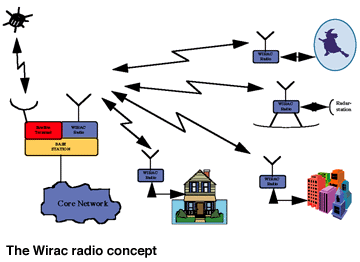
In cooperation with the Norwegian University of Science and Technology (NTNU), SINTEF Telecom and Informatics has started a long term research program financed by the Norwegian Research Council on WIdeband Radio ACcess (WIRAC). Here, more advanced radio access concepts based upon OFDM and CDMA will be studied. Also the influence of adaptive antennas is planned to be investigated. Keywords are multi-user detection, interference cancellation, multirate service multiplexing, Quality-of Service and multirate channel coding. These areas will be studied from a theoretical point of view, as well from the hardware side. Having a cross-disciplinary point of view is import, meeting a variety of requirements.
Please contact:
Knut Grythe - SINTEF Telecom and Informatics
Tel: +47 73 592683
E-mail: knut.grythe@informatics.sintef.no