ERCIM Institutes promote W3C Developments to leverage the Web for European Industry
by Jean-François Abramatic and Bob Hopgood
To enhance the communication between the World Wide Web Consortium (W3C) and the Web community, W3C will open W3C Offices covering specific geographical areas in the framework of the W3C-LA (Leveraging Action), one of the European Commission's 'Leveraging Actions for Software Technologies', sponsored by the Esprit programme. W3C Offices will be the first point of contact between the Consortium and its membership, as well as the general public in their corresponding region. CLRC has been established as the first W3C Office, covering the United Kingdom. Other Offices to be launched during the first quarter of 1998 include GMD, CWI, SICS and FORTH. The deployment of W3C Offices takes advantage of ERCIM's long-standing partnership between information technology research laboratories throughout Europe. The five Offices are also members of W3C.
Since the launch of the W3C European host at INRIA in April 1995, the membership has been developed and the W3C team in Europe is well established. Significant results have been achieved within W3C's three technical Domains Architecture, User Interface, and Technology &Society. The goal of W3C-LA, run by INRIA in partnership with CLRC, is to promote W3C results throughout Europe.
W3C-LA will develop awareness about W3C and encourage European industry to demonstrate the positive impact of the Web on future business. To assist technology and service providers as well as users, key initiatives will be developed to characterize the business drivers for and the impediments to the uptake of the Web's maturing technology opportunities. These include Demonstrators to express the innovative uses to which the core developments can be put, Mirroring and Translation, and Disseminators like Symposia and Workshops.
Demonstrators
To express the innovative uses to which the core developments can be put, shrink-wrapped demonstration packages will be developed and disseminated throughout Europe. Additionally, the demonstrators allow the Web community to feed its discussions by concrete examples and experimental developments. The demonstrators will be designed to address the following issues:
- Performance: to implement the evolving HTTP (HyperText Transfer Protocol) to impact the performance of the Web for the service provider and end-user
- Content Design: to use CSS (Cascading Style Sheets) and features of HTML (HyperText Markup Language) to achieve best practice for the content provider
- Trust: to utilize PICS (Platform for Internet Content Selection) to label, rate and filter material on the Internet and for workflow within an Intranet
- 'Europeanisation': to develop a real multilingual information service
- Web Collections: to create a set of Web pages that effectively are a single entity
- Synchronisation and Vector Graphics: to synchronise information in different media and to optimize performance for schematic and vector graphics.
Mirroring and Translation
The Web community uses the Web itself as the primary medium for communication. W3C is no exception; its site at http://www.w3.org/ is the leading reference source for information on the evolution of Web technology. This information is currently available from MIT in America, INRIA in Europe and Keio University in Asia. W3C-LA will enhance European access to W3C information by mirroring the INRIA site in various European locations. In addition, W3C will encourage translations of relevant parts of the W3C site content into non-English European languages, and address the consistency of information available in different languages.
Disseminators: Symposia and Workshops
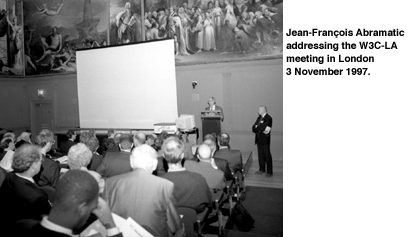
Meetings will be held to encourage organizations to start to use the Web infrastructure (particularly the demonstrator results) as a ubiquitous medium. As users and providers become involved, they will be able share their experiences in an interactive mode; to augment the continuous process conducted over the Web. W3C-LA will organize events throughout Europe to promote W3C demonstrator results and to seek feedback from the European community. These events will initially take place as open symposia describing recent Web advances and announcing the status of demonstrators in development. The first Symposium was organised in London, 3 December 1997. Other Symposia are being planned by the other Offices in the Spring of 1998. The following phase will have demonstrator advice workshops aimed at the industry champions familiar with the completed demonstrators. The final phase of the project will be events to disseminate user's experience of the demonstrators.
Please contact:
Jean-François Abramatic - W3C
Tel: + 33 1 3963 5463
E-mail: jfa@w3c.orgBob Hopgood - W3C
Tel: +44 1235 446822
E-mail: F.R.A.Hopgood@rl.ac.uk