HERMES - Supporting Argumentative Discourse in Multi-Agent Decision Making
by Nikos Karacapilidis
Multi-agent decision making is usually performed in the presence of ill-structured information, brought up by parties with different backgrounds and interests. In such environments, argumentative discourse may provide agents a means of pursuing their own objectives, by arguing in favour or against one's assertions, and resolving conflicts through iterative knowledge retrieval.
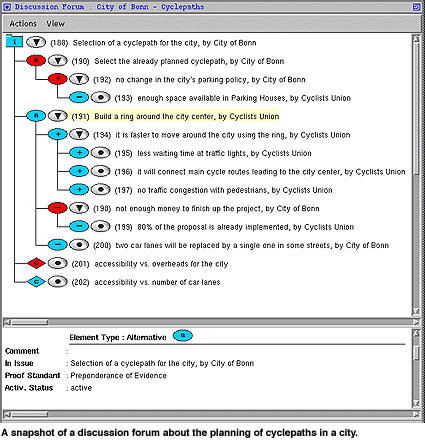
HERMES is a Web-based system that supports argumentative discourse in group decision making. The system organizes the existing knowledge in a discussion graph, which consists of issues, alternatives, positions and preference relations (see Figure). It provides means of expressing and weighing individual arguments and preferences, in order to support or challenge the selection of a certain choice. The system supports defeasible and qualitative reasoning. Argumentation is performed through a set of discourse acts which call a variety of procedures for the propagation of information in the corresponding discussion graph. Unlike most Web-based conferencing systems which merely provide threaded, hierarchical discussion forums, HERMES includes reasoning mechanisms that monitor the discussion, performing consistency checking and constantly updating the status of the discourse. The system focuses on distributed, asynchronous collaboration, allowing agents to surpass the requirements of being in the same place and working at the same time. It is fully implemented in Java applets (there is no need for the users to download the system), and can be run on the World-Wide Web using any standard browser.
In general, it is very difficult to completely automate the processes involved in argumentative discourse in such environments. HERMES rather acts as an assistant and advisor, by facilitating communication and recommending solutions, but leaving the final enforcement of decisions to the agents. The use of information technology may assist in various ways. One important goal for us was to provide easy access to the current knowledge, at any time. Another was to provide direct computer support for the argumentation process. In argumentative discourse, the quality and acceptability of decisions depends not only on the availability of accurate information, but also on the fairness and openness of the procedure. For example, when planning a site for storing hazardous wastes, the interests of the affected communities, environmental protection groups and local industries are likely to be in conflict. Involving representatives of these diverse interests in the decision making process at the earliest possible stage, can facilitate the extraction of a better plan and increase its approval by the interested parties. We have planned to evaluate the system with a real application on preventive medicine, starting at the end of 1997.
Future work involves implementation of an already specified framework where CBR and Argumentation Based Reasoning jointly aid the users to address various discourse instances. Use of precedent cases is well-suited in argumentation systems. Cases in our model are not merely considered as representations of past data, but as flexible entities associated with the underlying viewpoint of a user and the evolution of the corresponding discussion. We also plan to work on the application of linguistic labels to various argumentation elements. According to this approach, decision makers may assert the extent they are prepared to accept the arguments asserted by the others and the importance of each argumentation element. Finally, we intend to keep the work going on the application of measures of similarity between these elements, aiming at providing estimations of conflict or consensus between the decision makers involved. For more information on HERMES, see: http://aid.inria.fr/hermes/hermes_overview.html
Please contact:
Nikos Karacapilidis - Swiss Technological Institute of Technology
Tel: +41 21 693 2576
E-mail: Nikos.Karacapilidis@di.epfl.ch