POPINDA - Portable Parallelization of Industrial Aerodynamic Applications
by Anton Schüller
The use of computer simulations in the specification and design of modern aircraft have a decisive impact on the competition in the aerospace industrial market. Increasing demands for cost efficiency, speed, safety, comfort, noise reduction and environmental protection necessitate simulations with increasing complexity in the aerospace industry. Optimized codes running on high performance computers, ie parallel computers, must be used to meet those requirements.
In the cooperation project POPINDA (Portable Parallelization of Industrial Aerodynamic Applications), the innovative step into parallel computing has been completed: over a period of more than three years, the partners Daimler-Benz Aerospace Airbus GmbH, Bremen, Daimler-Benz Aerospace AG, Munich, Deutsche Forschungsanstalt für Luft- und Raumfahrt, Braunschweig, and GMD Sankt Augustin were involved in the collaborative development of the parallel programs FLOWer and NSFLEX-P for the computation of flow fields around aircraft. Additional partners were IBM Heidelberg and ORCOM GmbH, Freiburg. Both programs in POPINDA achieved a high standard in the area of Computational Fluid Dynamics (CFD) worldwide.
The parallelization strategy of FLOWer and NSFLEX-P, solving the Reynolds averaged Navier-Stokes equations, is based on grid partitioning and the message passing programming model. For message passing, both programs use the portable high level communications library CLIC (Communications Library for Industrial Codes), also developed in POPINDA. CLIC performs and optimizes all data exchange between the allocated processors, guaranteeing a high degree of efficiency and flexibility. Since the CLIC library supports the portable communication interfaces PARMACS and MPI (and since the CLIC library was also developed for sequential platforms), both programs can be run on any parallel and sequential platform.
During POPINDA, the parallelized production codes were tested in industry. They proved to be independent of the hardware and significantly faster than the old industrial production codes. Moreover, a careful validation showed the high quality of the results leading to an increased confidence in computational flow calculations. POPINDA made an important contribution towards an improved efficiency and competitiveness of the German aerospace industry.
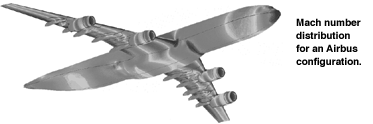
Using the POPINDA parallel programs, it is currently possible to calculate the flow field over a wing-body-configuration with extremely high resolution on a grid consisting of over 6.5 million grid points. Such a calculation corresponds to the solution of a non-linear system of equations with more than 33 million unknowns. Remarkably, the results are available in less than three hours.
On top of that, new algorithms were developed for further reduction of the computation time of a flow calculation. Especially the adaptive methods must be mentioned here, in which the number of grid points and thus the size of the system of equations to solve is fitted to the concrete problem in an intelligent way. The accuracy of numerical calculated flow data principally increases with increased grid resolution, ie with an increased number of grid points. However, the grid resolution of the total grid must not be necessarily constant. In large, but a priori unknown parts of the flow field a lower grid resolution is sufficient to reach a prescribed accuracy than in others.
Both POPINDA codes FLOWer and NSFLEX-P lay the foundation for current as well as future research and development projects in the area of numerical flow simulation. FLOWer, for example, is one of the foci of the MEGAFLOW national CFD project, aiming at the goal of achieving the simulation of a complete aircraft at cruise and take off/landing conditions with a reliable, efficient and quality controlled program system.
With the POPINDA programs, the way towards future challenging CFD problems has been prepared. Among other algorithmic developments, some issues are highlighted here:
- the development of flexible grid and data structures - the numerical simulation of unsteady flows around aircraft - the optimization of aircraft components with respect to interference effects and
- the coupled solution of structure mechanical and aerodynamic problems, a very important issue in the process of wing design.
More information on Popinda at http://www.gmd.de/SCAI/num/popinda/popinda.html
Please contact:
Anton Schüller - GMD
Tel: + 49 2241 14 2572
E-mail: anton.schueller@gmd.de