Open and Distant Training Techniques for Small and Medium Enterprises
by Paolo Bianchetti, Stefania Manca, Donatella Persico and Luigi Sarti
"Distance Training for Small and Medium Enterprises" (in Italian "FADxPMI Formazione A Distanza per le Piccole e Medie Imprese") is a project being conducted by the Institute for Educational Technology of the Italian National Research Council (ITD-CNR) and funded by the Provincial Administration of Genoa. The aim of the project, which begun in 1996 and is now in its final year is to support the Provincial Administration in the transition from the present training system, mainly based on traditional techniques, to one that includes distance training to meet the needs of small and medium enterprises (SMEs) in the Italian region of Liguria.
In the field of professional training in Liguria, the need has emerged to support a transition from traditional methods (face-to-face lessons) to the innovative field of Distance Training. In particular, where in-service training of staff is concerned, the nature and size of local SMEs is such that it is unrealistic for their staff to leave the workplace for a significant amount of time. Unfortunately, at the moment, agencies and schools for professional training seem to lack know-how in the design and development of Distance Training courses. There is also a need for the definition of a system that fits in with the local context, with facilities and infrastructures that can support the training of professionals and institutions in the process of designing and running distance courses.
The FADxPMI project is a joint initiative of the Provincial Administration of Genoa and ITD-CNR which aims at dealing with these problems through the following actions:
- a systematic study of distance training techniques and methods, where the potential of different communication media and training techniques is analysed and evaluated against the main features of the training problems existing in our specific context
- the dissemination of know-how in the design of distance training events among trainers and course designers belonging to local training institutions
- the development of proposals for a distance training system suitable for the local context.
Distance Training Techniques and Methods
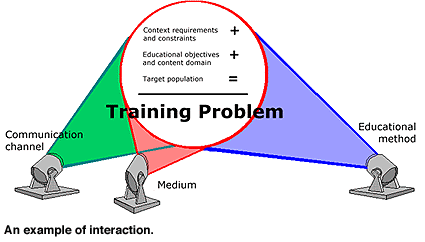
Action 1, which was completed in 1997, entailed the production of a comprehensive report where the pros and cons of print, audio, video, computers and telematics in distance training are discussed, as well as the ways in which such media can be employed. The standpoint of this report is that a training problem can be defined, as shown in the Figure, in terms of:
- target population
- educational objectives and content domain
- context requirements and constraints.
Solving the training problem will consist in carefully orchestrating different techniques, media and teaching strategies according to heuristic criteria which maximise the cost/benefit ratio, though this is not always quantifiable. The report focuses on the identification of these criteria.
Dissemination of Know-how in the Design of Distance Training Events
The second action comprises the design and implementation of a course for trainers and designers belonging to local training institutions as well as the creation of a website to support this and future training events on related subjects. The enhancement of both awareness and skills in using Distance Training techniques will enable training professionals not only to improve the flexibility and the effectiveness of their educational initiatives, but also to gain easier access to available funding, for example from the European Union Social Fund.
The course will focus on methodologies and tools as well as design principles of Distance Training, and will provide participants with the opportunity to try out most of these aspects from the perspective of both the tutor and the student. It will include 14 weekly face-to-face lessons as well as distance training activities, consisting of individual and group work. Individual work will be based on various kinds of material (print, audio, video and web-based material) while group work will use a computer conferencing system.
Participants will carry out collaborative activities aimed at designing distance training materials and events, while participating, at the same time, in one such event. The website contains part of the course materials (access limited to course participants) and provides access to the computer conferencing facilities.
Developing a Distance Training System for the Local Context
Action 3 started in 1997 and includes:
- a world-wide analysis of the most commonly used approaches in Distance Education for in-service personnel of SMEs
- a study of Distance Education systems and models and an analysis of the main functions that must be carried out by a Distance Education institution
- the development of specific proposals for Liguria, such as the creation of infrastructures that "factor out" activities currently duplicated by different training institutions, or are not carried out at all because too expensive for a single institution (eg production and adaptation of materials, training needs identification and evaluation, etc).
Conclusions
The FADxPMI project should promote a gradual though powerful process of change in the present training system in Liguria. The policy adopted is to create a synergy between research results and daily practice. If the project succeeds, then similar dynamics and, possibly, part of the technology produced within this project could well be applied to other areas of the country.
For further information on the FADxPMI project see: http://paradiso.itd.ge.cnr.it/english/projects/odlxsme/dlxsme_eng.html
Please contact:
Donatella Persico - ITD-CNR
Tel: +39 10 6475313
E-mail: persico@itd.ge.cnr.it