Abstract Test Suite
by Katalin Tarnay and Abdalla Areik
With the increasing number of different communication networks and protocols, it comes more and more important to check whether a protocol implementation is conform to the formal specification. A new method for analysing abstract test suites, a fundamental step of conformance testing has been developed at the Communication Protocol Laboratory of SZTAKI.
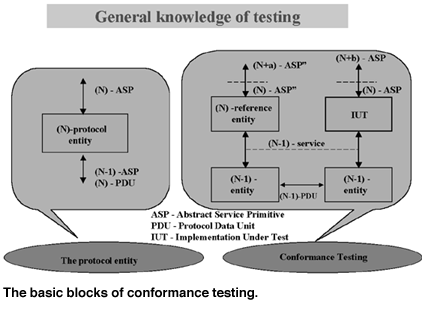
A communication protocol can be considered as an (N)-Protocol entitiy having upper and lower interfaces. The Protocol Data Units (PDU) and the Abstract Service Primitives (ASP) cross these interfaces. The basic blocks of conformance testing can be seen in the Figure. The Implementation Under Test (IUT) is tested in a layered architecture. N stands for the layer number, the test methods are abstract. An abstract test method describes how an IUT is to be tested, given at an appropriate level of abstraction to make the description independent of any particular realization, but with enough detail to enable tests to be specified for this method.
The fundamental notion of conformance testing is the abstract test suite. Traditional methods to derive an abstract test suite are based on extended finite state machines or labelled transition graphs. Our new idea is based on AI tools, namely on rule-based systems. The advantage of using this method is to get better information with higher confidence and to have wider possibility to modify the test actions.
The abstract test suite is composed of abstract test cases. An abstract test case is a complete and independent specification of an action required to achieve a specific test purpose. According to our method, test steps and test cases are converted to a rule-based system.
Rule-based system representation provides the possibility of integrating expert systems into the conformance tester. The most popular mode of knowledge representation within expert systems is the mode obtained by the use of rules or rule-based systems. Such rules are called IF-THEN. For understanding and maintaining, validation and ease of documentation, some kind of rule organization should be followed. Each group should be ordered, the rule-group ordering is determined according to the conclusion attributes, but it is often advocated to limit the rule to a single conclusion attribute.
The application of a rule-based abstract test suite will be demonstrated on a simple protocol called Inres Protocol. This is a connection oriented protocol that operates between two entities, the Initiator and the Responder. The protocol entities communicate by exchanging the Protocol Data Units (CC, CR, DT, AK and DR.) The communication between two protocol entities takes place in three distinct phases: connection establishment, disconnection, and data transfer phase. In each phase only certain Protocol Data Units and Abstract Service Primitives have meaning.
In our research we try to use a rule-based system for conformance test cases. In other words, we attempt to generate from the test cases written in TTCN notation (Tree and Tabular Combined Notation) rules. Since the description of the test cases is in TTCN and we want to convert these cases to rule-based systems, we can use other specification languages (eg SDL) as well. Confidence factors and uncertainity can be related to the rules. This method is expected to be applied in protocol engineering. It is especially interesting for abstract test suite developers. These applications provide a feedback to further research.
Please contact:
Katalin Tarnay - SZTAKI
Tel: +36 1 209 5400
E-mail: tarnay@sztaki.hu