Water Quality Modelling in the Channel Network of Venice
by Lucia Zampato, Georg Umgiesser, Martina Bocci and Giovanni Coffaro
In Venice a new activity has started aimed at the hydrodynamic and water quality modelling of the city's inner channels. This project is considered to be important because of the problems the city of Venice has with pollution of its water and sediments. A two-dimensional finite element hydrodynamic model is used to simulate the behaviour of the lagoon surrounding the city; the modelling system WASP is used to describe the hydrodynamics of the inner channels and the quality of the water. A team of scientists from the Italian National Research Council (CNR) and the University of Padua carry out the modelling activity within the framework of the 'Inner Channels of Venice' Project, which begun in 1994. The project is coordinated by UNESCO's UVO-ROSTE Office in Venice and financed by the Italian Ministry for Scientific Research.
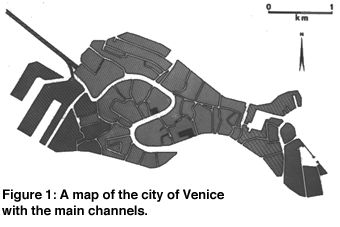
The city of Venice is uniquely structured, since it is constituted by small islands surrounded by a complicated network of channels that communicate with the lagoon. Even today, this channel system constitutes the principal way of communication for people, goods and public services.
These channels are also the collectors of pollutants; the most important of them are the sewage waters. Stopping the dredging of channels between the end of the 1960's and 1994 has worsened this problem and makes the pollution of water and sediments a very pressing problem for the city. Inquiry into the possible solutions to the problem of cleaning the channels is the general objective of the project 'Inner Channels of Venice'. The concluding part of this project was started at the beginning of 1998 and is expected to terminate at the end of 1998.
Main research subjects in the project include:
a) the quality of water and sediments
b) the health of the inner channels
c) water quality modelling.
Topics a) and b) are performed through field measurements and laboratory analyses; they concern hydrodynamic quantities (velocity, water level), ecological parameters (temperature, salinity, pH, dissolved oxygen, nitrogen and phosphorus compounds and others), and biological indicators (virological parameters and pathogenic bacteria).
The activities in which the authors are directly involved regard the implementation of the water quality model (WASP) to the channel network of Venice. The possibility to simulate the hydrodynamic behaviour of the channels, and the evolution of biological parameters with different tidal regimes, meteorological conditions and morphological configurations, give an important contribution to this study. The research, co-ordinated by a team of international experts, is carried out in Venice by a group of local scientists.
Modelling Activities
The aim of the modelling activity is to obtain a description and therefore a better understanding of the hydrodynamic and eutrophic processes in the inner channels of the city of Venice. The activities planned are:
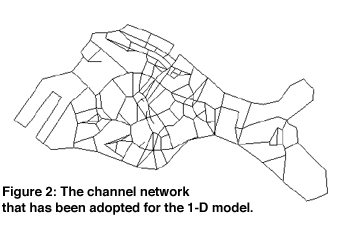
- the implementation of a 1-D hydro-dynamic model to the channel network and its coupling with a 2-D hydrodynamic model for the lagoon of Venice, that provides the boundary conditions around the city
- the application of a water quality model to the inner channels.
To accomplish these tasks the following models will be used:
- a 2-D finite element model of the Venice Lagoon (Umgiesser, 1986): the grid of the model is made up of 4359 nodes and 7842 triangular elements describing the varying bathymetry. Forcing functions of the model are height of sea level at the three lagoon inlets, wind blowing over the lagoon and the discharges from rivers into the lagoon. The grid of the model will be modified in the area around Venice to allow the coupling with the 1-D model of the inner channels.
- The WASP-EPA model will be used to simulate water circulation and water quality of the channel network. DYNHYD, the hydrodynamic module of WASP, will be used to describe the water circulation; the model is based on a link-node approach and provides water velocity and waterlevel values. The model will be calibrated by means of the Manning coefficient with data on water level and velocity recorded during the field campaigns. The results of DYNHYD will be used in simulating the water quality. EUTRO, the water quality module of WASP, will be used to model the dynamics of the following water quality parameters: dissolved oxygen; organic carbon; nitrogen (as nitrate and ammonia); phosphorus (ortho-phosphate); chlorophyll-a; and suspended matter (modelled by means of the TOXI sub-model). Nitrogen, phosphorus, and suspended matter loading in the channels will be computed from data on the resident population and tourists and from water consumption data and specific conversion factors. Boundary conditions for the water quality will be extracted from the available water quality data in the area of the lagoon surrounding Venice. Initial conditions will be set according to field data gathered in the framework of this project and considering other data from the UNESCO database.
Conclusions
The model will be calibrated through the comparison with data already available, or collected in the field measurements during 1998. Future activities are planned in the framework of the project regarding the dredging of channels carried out by the municipality of Venice:modelling of hydrodynamics and water quality in the channels is an effective tool to better plan the excavation works and to predict the consequence of these on the water circulation and environmental health conditions. For further information, see: http://www.isdgm.ve.cnr.it/~georg/
Please contact:
Georg Umgiesser - ISDGM-CNR
Tel: +39 041 521 6875
E-mail: georg@lagoon.isdgm.ve.cnr.it