STOY - An Information System for Environmental Noise-Planning
by Ole Martin Winnem and Hans Inge Myrhaug
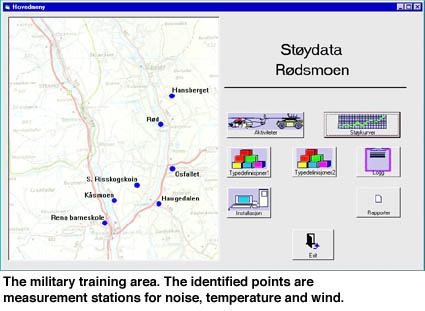
The new international airport at Gardermoen forced the Royal Norwegian Army to relocate their activities to Rena. This movement into a new area with farmers and small villages at both sides of the training area put major constraints on what training that can be performed in the area. SFT (Norwegian Pollution Control Authority) has given rules for the training regarding time of activity, noise in the nearest buildings and area of training. The area where the new training fields are located has cold winters with stationary air down in the valley. This can give a temperature variance of 20(C from the training area in the mountains and down in the valley where the civilian population lives.
Listeners are affected by the time of day when the noise is heard. During the day, they can accept much noise, in the evening they accept less noise, and at night they are very sensitive to noise. Also, the kind of information they are given in advance regarding noisy activities, influences their attitude to the noisemaker. If they are given no information, they tend to get more frightened when loud and warlike noises occur. On the other hand, if a noisy activity is announced in advance as an airplane show, they can accept almost any kind of noise.
The kind of weather and the time of the year are also important factors. During winter people are much more indoors and thus isolated from the noise. During summer - and particularly when the weather is nice - people are outdoors and therefore much more sensitive.
With these conditions the military have to optimise the activity regarding to noise.
The Monitoring and Planning System
STOY (noise) is a project for logging, monitoring, identifying, computing and planning noise.
The system is based on seven components: User Interface component, Monitor component, Estimation component, Planning component, Database component, Logging component and the Noise recognition component.
The logging component retrieves data from seven stationary and one mobile measurement station for noise and weather conditions. And then send them to the Database component. The database component stores the logged data, the calculated data, the recognised data and the data from the planning component. The Noise recognition component retrieves the logged data from the database and identifies the noise source. The Monitoring component is the day-to-day monitoring system for the user. The Estimation component estimates the noise propagation for a given noise source by using a mathematical model that pays respect to terrain formations. The Planning component is the support system for activity planning. The component has two subparts, one for generation of plans and one for critique of plans. The planning component is using knowledge intensive case based reasoning and rules for evaluating the plans.
Other Application Areas
The military all over the world gets more and more restrictions on their training. This gives a market for noise planning systems to help them plan their activities inside the restriction threshold.
Major airports are getting new restrictions on how much noise they can generate, and the airplane companies are getting restrictions on how much noise they can create on a particular airport. Both have a planning problem for which type of plane that can be used to maximise the number of passengers they can transport.
Industrial noise has become a problem all over the world. An example is fields for testing of plane engines where the company must plan the activity according to the civilian population in the area.
Please contact:
Ole Martin Winnem - SINTEF Telecom and Informatics
Tel: +47 73 59 29 93
E-mail: Ole.M.Winnem@informatics.sintef.no