

ERCIM News No.35 - October 1998
ERCIM News No.35 - October 1998
Networked Digital Library of Theses and Dissertations
by Edward A. Fox
In July 1998 the National Library of Portugal joined the Networked Digital Library of Theses and Dissertations (NDLTD) with plans to support the universities of Portugal in shifting to electronic theses and dissertations (ETDs) and making them widely accessible. INESC is providing technical assistance through its efforts with digital libraries, led by José Luis Borbinha. This may serve as a model for other ERCIM organizations to become members of and assist in the growth and development of NDLTD.
NDLTD is a worldwide federation of universities and supporting organizations with the goal of having every thesis and dissertation be prepared electronically and then made accessible through a distributed digital library. Eventually this will become one of the world’s largest digital libraries, with the potential of 200,000 multilingual hypermedia works being added each year. Its content will make it an invaluable resource for ERCIM and other organizations. Also, it serves as a valuable testbed since all of the important research problems in the field of digital libraries can be addressed in the context of NDLTD.
Beyond Portugal but also in Europe, there is an NDLTD member university in Darmstadt, Germany. UK hosts the University Thesis Online Group (UTOG) which is represented on the Steering Committee of NDLTD. Since all universities are invited to join NDLTD, it would be possible for ERCIM members to pair up with neighboring universities and assist them in shifting from paper to electronic handling of their graduate research documents. NDLTD aims to improve graduate education, ensure that the next generation of scholars have skills and understanding regarding digital libraries and electronic publishing, and to assist universities in developing infrastructure to have their own digital library.
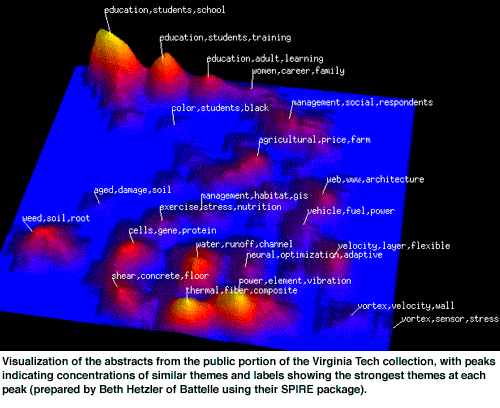
Though ETDs were first discussed in a 1987 meeting hosted by UMI about application of SGML to this genre, NDLTD only emerged in September 1996 when Virginia Tech was awarded a grant from the US Department of Education. In January 1997 Virginia Tech began requiring ETDs. The figure (prepared by Beth Hetzler of Battelle using their SPIRE package) shows a visualization of the public portion of the Virginia Tech collection, with peaks indicating the largest clusters and labels giving the cluster’s three most common words. By June 1998 the collection included over 1100 works, with approximately two-thirds including multimedia content, such as images, videos, audio files, Java applets, AuthorWare and Director files, collections of data, and VRML files. There were about 200,000 downloads to-date of the full content of ETDs, reflecting the enormous worldwide interest.
NDLTD operates as a federation, with each university or group having its own collection and search system. A prototype search gateway at Virginia Tech searches sites in parallel, and includes a simple dictionary database so English queries are translated into German to allow searching of a German collection in Graz, Austria. NDLTD members in Korea and Singapore will assist with more advanced technologies for multilingual search. Since Virginia Tech is one of the founding members of NCSTRL, the Networked Computer Science Technical Reports Library (http://www.ncstrl.org) running the backup server for that project, interoperability tests are planned with servers running the Dienst software as well as those with Z39.50 capabilities.
Virginia Tech provides support for universities to learn about and join the project, offers about 300 megabytes of training materials and other content to help student authors, gives software to allow automation of the handling of ETDs by graduate schools and libraries, and works with publishers and others to advance the goals of the initiative.
Members of NDLTD maintain their local site and adapt the materials available to their situation. They freely share with other members, and have benefited from donations made by IBM, Adobe, Microsoft, OCLC and others providing hardware and software assistance.
With the involvement of INESC and the National Library of Portugal, NDLTD has a first link with ERCIM. Further collaboration with Europe is encouraged to complement national projects already funded in the US and Australia, and proposed efforts in Russia and elsewhere. Meanwhile, researchers are encouraged to use the growing collection available at http://www.theses.org.
NDLTD website: http://www.ndltd.org
Please contact:
Edward A. Fox - Director NDLTD, Virginia Tech
Tel: +1 540 231 5113
E-mail: fox@vt.edu