

ERCIM News No.35 - October 1998
ERCIM News No.35 - October 1998
SCORE - Scene COmplexity REduction for Real-Time 3D Environments
by Boris Groth, Juan Carlos Escudero and Roberto Scopigno
In the context of the bilateral agreement for scientific collaboration between the German National Research Centre for Information Technology (GMD), Germany, and the Italian National Research Council (CNR), Italy, signed on 16 December 1997, the institutes of FIRST in Berlin and CNUCE and IEI in Pisa are now working jointly on a project for the automatic acquisition and real time 3D visualisation of artistic and cultural data.
A realistic and intriguing virtual visit of the Guggenheim Museum in Bilbao (Spain) aroused considerable interest when it was shown recently (June, 1988) to the visitors of the German Museum of Science and Technology in Bonn. This demonstration program is the first, relevant result of the recently set-up scientific co-operation between FIRST-GMD , CNUCE-CNR and IEI-CNR.
The museum is a modern building with complex and futurist shapes. The 3D NURBS-based model of the museum, courtesy of Urbetipo, Bilbao (Spain), was converted into a data representation based on triangular meshes and then simplified using Jade 2.0, a surface simplifier developed jointly by CNUCE-CNR and IEI-CNR in Pisa. Surface simplification was performed in order to drastically reduce rendering times. FIRST was responsible for developing the system for real time virtual navigation of the museum (collision detection handling, texture mapping, realistic rendering, etc.).
This result represents just the first step of the more articulated and complex project SCORE (Scene COmplexity REduction for Real-Time 3D Environments); in the near future participation in the project will be extended to other institutions of the European Union. The goal of SCORE is the development and integration of technologies for the automatic acquisition (ie, gathering data in digital form), management (ie, cataloguing, archiving, simplification of geometric models), and exploitation (visualisation and manipulation) of three-dimensional model databases. The artistic and historical artefacts acquired will cover a wide spectrum (from architectural complexes to sculptures, from pottery to jewellery, etc.) and therefore will require the tuning of adequate techniques for data acquisition and processing. Adequate real-time authoring and visualisation environments will be built for evaluation of the project results with different examples of architectural and cultural heritage models.
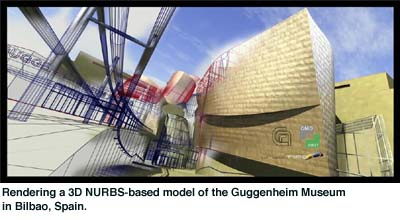
SCORE especially deals with the optimisation of the process to transform CAD-data, NURBS-based models, or 3D cultural heritage objects acquired by range scanners into real-time 3D-databases and appropriate handling of scene complexity within interactive visualisation environments. SCORE relates to other GMD-FIRST research-projects in aspects of adequate I/O devices like HMD’s, Trackers, etc. (FACIT) for convenient interaction techniques, possibilities of remote rendering for low-end platforms (ESRA, GO-WEB), hardware supported high-quality visualisation (VISA+), repository based scene decomposition and CSCW support (PIROL), and to other CNR special research projects aimed at the preservation of the cultural heritage and simplified multiresolution 3D data representation (CNR Project ‘Safeguard of Cultural Heritage’).
Please contact:
Boris Groth - GMD
Tel: +49 30 6392 1782
E-mail: Boris.Groth@gmd.de
Roberto Scopigno - IEI-CNR
Tel: +39 050 593304
E-mail: r.scopigno@cnuce.cnr.it
Juan Carlos Escudero - Urbetipo, Bilbao
Tel: +34 4 416 06 61
E-mail: urbetipo@cimv.es