

ERCIM News No.35 - October 1998
ERCIM News No.35 - October 1998
Second European Conference on Research and Advanced Technology For Digital Libraries
by Christos Nikolaou
The Second European Conference on Research and Advanced Technology for Digital Libraries (ECDL’98) was held in Heraklion, Crete, Greece, 21-23 September 1998, and was organised by the Institute of Computer Science (ICS) of the Foundation for Research and Technology - Hellas (FORTH) in co-operation with the Department of Computer Science of the University of Crete. ECDL’98 builds upon the success of the first of this series of European Conferences on Research and Advanced Technology for Digital Libraries, held last year in Pisa, Italy, September 1-3, 1997.
This series of conferences is partially funded by the TMR Programme of the European Commission and is actively supported and promoted by ERCIM. The aim is to bring together the different communities involved in the development of Digital Libraries, to review progress and to discuss strategies, research and technological development (RTD) issues, as well as specific topics related to the European context. These communities include professionals from universities, research centres, industry, government agencies, public libraries, etc. One of the main objectives is to promote and sustain an international and multi-disciplinary Digital Libraries community, facilitating scientific and technological progress, enabling growth of the available infrastructure and services, increasing the dissemination bandwidth and attracting further interest, particularly from young scientists.
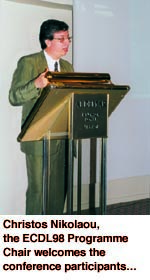
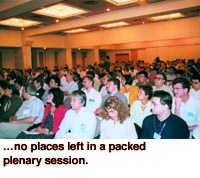
ECDL’98 was a truly international event of a distinctively interdisciplinary nature. This year’s conference can be considered as a major success: participation has tripled since last year with 450 participants from 45 countries around the world. The international programme committee of the conference comprised 32 representatives from 13 countries. In total, 107 papers were received, a significant increase from last year, which were assigned to 56 reviewers. The significant increase in the number of paper submissions marks the growing interest that the field of Digital Libraries has attracted over the past year. Following a rigorous peer review selection process, where each paper was reviewed by at least three reviewers, 35 full papers were selected. The high quality of the submitted papers also indicates the rapid progress that is taking place in this emerging technological field. Additionally, the conference features 1 keynote speaker, 10 invited talks, 7 tutorials, 32 posters, 6 panel sessions, 2 special sessions, 13 demonstrations, and 9 DELOS Workshop papers.
A digital library constitutes a quantum quality leap over a simple electronic collection of books and journals. It is an active super-entity composed of active or passive information objects that live scattered around the world and are accessible through the Worldwide Web. Examples of such information objects are: documents in digital form together with their readers’annotations and the responses of their creators; sounds and pictures - moving or still - with their descriptions and their annotations; programs with their animation graphics and sample inputs for experimentation; collaboration environments for research (eg teleguidance of a roaming underwater autonomous vehicle off the Mediterranean coast and collection of its measurements to feed a mathematical model for the prediction of coastal pollution) or entertainment (eg virtual reality games on the Internet).
The Alexandrian daughter library was established about 235 BC by Ptolemy III in the Temple of Sarapis, with the ideal of an international library -incorporating not only all Greek literature but also translations into Greek from the other languages of the Mediterranean, the Middle East, and India. The scholars of Alexandria had immediate access to an enormous collection of works by the standards of their time. In theory, all these works were accessible by the scholars even without the library - provided they found a copy of the work they were searching somewhere in the world, something practically impossible most of the time.
In a similar way, an abundance of information objects lives, evolves, grows and dies in the ocean of the World Wide Web. In theory, humans can seek them through Internet’s search engines, and if they are lucky enough find them, and interact with them. However, in reality, this has become increasingly difficult, as the number of objects and the size of Internet grow geometrically with time.
A digital library acts as an agent for both humans and information objects in cyberspace. The creators of the information objects can entrust their creations to the digital library, which safeguards their authenticity, protects them from plagiarism, and ensures their promotion and evolution as conceptual artifacts that interact with others in the world. The digital library informs all entities, human or otherwise, about the information objects that it supports. It negotiates and enters into contractual agreements with other digital libraries for the exchange of access rights to objects.
This drastically new understanding of libraries is expected to have a dramatic social and economic impact world-wide. Creators’ intellectual property rights, publishers’ commercial rights, the very nature of publishing, citizens’ access rights, the nature of the public library and the museum are some of the areas that are being re-examined and redefined. The enforcement of the access rights of the citizens of the emerging Information Society becomes paramount, through access techniques tailored to the individual capabilities, requirements, skills and preferences of the individual user.
The conference was an international Forum - not simply European - where these important issues were discussed among researchers from multiple disciplines whose science relates to the development of digital libraries. It provided an opportunity for these scientists to form a research community in Europe specific to digital library development; to enable review and discussion of research under way in Europe, the US, Japan and other countries on digital libraries; to establish a forum for discussion of issues specific to Europe such as interoperability, multilinguality, intellectual property policy, and electronic commerce.
Some of the important presentations and demonstrations at the Conference were the following:
- Aquarelle, a digital library for cultural material that was built by a large European consortium with the participation of ERCIM, museums and publishers
- ERCIM’s multilingual digital library for the Computer Science Technical Reports
- the second generation of Digital Library architectures, based on Java and Corba technologies, such as the Aurora architecture proposed by the Pleiades research group of FORTH and the University of Crete, or the FEDORA system proposed by a research group at Cornell University, U.S.A.
- white papers on the research agenda for Digital Libraries, prepared by the joint efforts of European and American working groups with support from ESPRIT in Europe and NSF in the United States.
The ECDL’98 Conference Proceedings, edited by Christos Nikolaou and Constantine Stephanidis, have been published in the Lecture Notes on Computer Science Series of Springer, LNCS 1513, ISBN 3-540-65101-2.
A special issue of the International Journal on Digital Libraries (IJODL), entitled ‘In the tradition of Alexandrian Scholars’ will be dedicated to results of the Conference. The purpose of the special issue is to offer to the international Digital Libraries community a collection of the best ECDL’98 Conference results, while, at the same time providing to the authors of the Conference Proceedings an opportunity to present a more detailed account of their work. Following a limited call for ECDL’98 papers and a new peer review procedure, this IJODL special issue, to be printed in 1999, will publish papers by authors that have contributed to the ECDL’98 Conference Proceedings. Guest Editors of the IJODL special issue are Christos Nikolaou and Constantine Stephanidis.
Please contact:
Christos Nikolaou - ICS-FORTH
Tel: +30 81 39 16 76
E-mail: nikolau@ics.forth.gr