

ERCIM News No.36 - January 1999
ERCIM News No.36 - January 1999
Vanilla: Towards more Modular Programming Languages
by Simon Dobson
The emergence of the Internet as a commercial force is now well under way. A particularly powerful business model is the notion of a ‘virtual enterprise’, a temporary alliance of companies brought together to exploit some transient market opportunity. Such systems typify a class of applications in which a set of components must be composed in a highly dynamic manner. As well as the obvious correctness issues, it is clear that notions such as webs of trust, role-based interactions and on-the-fly adaptability are neither properly understood nor well supported by current programming language technologies.
Trinity College Dublin has a long-term interest in very large-scale distributed systems. We felt that there was a need to experiment rapidly with novel language constructs for component composition, object re-use models and non-standard type checking. We were also concerned by the change in programmer demographics away from dedicated programmers happy with mainstream languages and towards domain specialists needing targeted, high-level scripting languages in which to write their own applications. Traditionally, programming language research has had an unacceptably high barrier to entry. A tool such as compiler or interpreter is a large, complex software system, which is difficult to understand and modify. This makes it difficult to experiment with minor changes to full languages, or to create ‘bespoke’ domain-specific languages.
The Vanilla project applies component-based program composition to the construction of the language tools themselves. Vanilla allows the language designer to construct a language by combining a number of components (or ‘pods’), each of which captures the syntax, type-checking and behaviour of a single language feature. A typical pod might define a feature such as the integers with a particular concrete syntax for the numbers and operators, a parser to the corresponding abstract syntax, a type checking component to ensure the type-correctness of programs and an interpreter component to evaluate the expressions. The individual components may be changed independently, for example allowing a new concrete syntax to be defined while re-using the existing types and behaviours. New features may be defined in isolation before being combined with other features to create the final language. This incremental, experimental approach greatly reduces both complexity and development times.
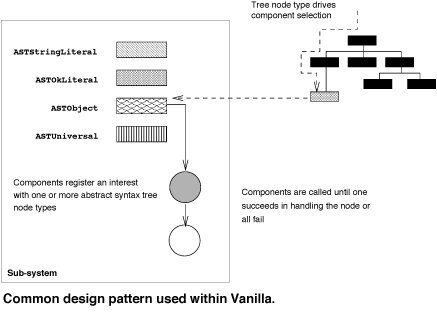
A common design pattern used within Vanilla (shown in the figure) allows components to express an interest in one or more abstract syntax tree node types. On encountering such a node the system walks the chain of interested components, allowing each in turn to either deal with the node, determine an error condition, or ‘pass’ the node to the next component in the chain.
We have constructed a number of standard pods covering a large portion of the language design space - including procedural, functional, object-oriented and ‘typeful’ language features. It turns out that many features are orthogonal to each other, so (for example) it is possible to define object types without committing to exactly what types may compose the members. This makes for some interesting generalisations to well-known concepts.
Of particular interest are the pods handling network interactions, for example with CORBA objects. We use a component-based mapping between Vanilla and CORBA IDL, which allows applications to access objects on the Internet with the absolute minimum of additional code. Moreover, by completely separating the protocol handlers from the rest of the application, we allow the same code to be used simultaneously via a number of different protocols (CORBA, DCOM, event-based models etc). This radically simplifies the construction of applications in highly heterogeneous environments.
We are currently using Vanilla to explore four complementary language areas: mobile objects and agents, novel object composition patterns, dynamic construction of applications based around XML document, and scripting languages for describing interactions with intelligent buildings. More information on the Vanilla project at http://www.cs.tcd.ie/Virtues/Vanilla/
Please contact:
Simon Dobson - CLRC and Trinity College Dublin
Tel: +353 1 608 2224
E-mail: simon.dobson@cs.tcd.ie