

ERCIM News No.36 - January 1999
ERCIM News No.36 - January 1999
MOVY - Wireless Sensor for Gestures, Rotation and Movement
by Peter Henne
Increasingly, innovative applications need to be able to sense spontaneous (natural) movements of the user. This need is obvious for a head-mounted display (data helmet) that lets the user look and wander around in a virtual 3-D world. More recently, the idea to capture and communicate natural gestures to manage net-based teleconferencing applications has defined a new set of requirements for motion sensors (trackers). MOVY is a wireless input device that captures the user’s gestures, movements of the hands or the head, shifts in the focus of vision or any unspecific movement that a program may be able to interpret.
Magnetic trackers are widely used today. This technology uses a strong artificial magnetic field. The sensors that move about in this magnetic field can capture the variations in its direction and strength. They determine position and movement of the tracker on that basis. Besides their high price, magnetic trackers have some technical shortcomings: it takes considerable time and effort to install and to calibrate them. The natural magnetic field and even metal objects may confuse the sensors, the space where movement can be captured is rather limited.
Requirements for the next generation of trackers would include:
- the tracking technology does not rely on any artificial external sources
- the tracker can use wireless data transmission to get the data into the computer, so that no cabling hampers spontaneous and natural gesturing
- the tracking device proper should be small enough to fit comfortably in the user’s hand or to be worn like a ring on the index finger
- the tracker should, above all, be easy and cheap to produce.
MOVY
At the GMD Institute for Applied Information Technology, the MOVY inertial tracker has been developed to meet these requirements. At the moment, three hand-crafted prototypes are available for experiments. At their core are three semiconductor accelerometers, one each for the X, Y and Z axis, that respond to changes in velocity producing a proportional voltage. The sensors in the MOVY prototypes can capture acceleration in the range of 4 mg to 2 g, up to 50 hz.
The analog signals are converted in a microprocessor that outputs, in a stream of serial (RS232)-frames, the raw acceleration data to a small radio transmitter. The corresponding receiver feeds the data into the serial port of a PC that runs the driver program which computes MOVY’s orientation and location in X, Y and Z.
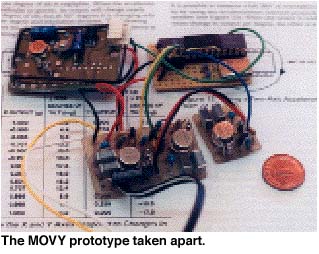
The first MOVY prototype including the radio transmitter draws about 40 milliamperes, ie, it can operate on a small battery. This allowed to fit the MOVY in a 45 x 50 x 38 mm case. To show the potential for further miniaturization, the latest MOVY is a modular, two accelerometer design: the sensors are fitted to a ring for the index finger, with a light cable running across the hand to the microprocessor and radio transmitter in a small box strapped to the wrist.
Performance
MOVYs are about one tenth the size of the trackers in use today. If mass-produced, MOVYs could be fairly cheap. MOVYs are good at determining orientation. Pitch and roll data have an accuracy of 1.4 degrees. The MOVY prototypes are less good at determining location: location data produced by integrating acceleration data are reliable only in specific situations.Please contact:
Peter Henne - GMD
Tel: +49 2241 14 2688
E-mail: peter.henne@gmd.de