

ERCIM News No.37 - April 1999
ERCIM News No.37 - April 1999
AMC - ATM based Wireless Mobile Computing
by Enrico Gregori and Thomas Luckenbach
Within the framework of a scientific co-operation between GMD and CNR, at the end of 1997, GMD Institute for Open Communication Systems in Berlin and CNUCE-CNR in Pisa began to work on developing a wireless access technology to be integrated in the ATM technology.
The objective of a collaboration now under way between FOKUS-GMD and CNUCE-CNR in the wireless mobile computing area is to implement an efficient connection of mobile devices capable of wireless communication with the World Wide Web. A wireless access technology (based on the DECT - Digital Enhanced Cordless Telecommunications - interface) has been deployed to connect mobile devices to backbone ATM networks. Up to now, the emphasis has been on mobility support in ATM infrastructure networks. However, besides the wireless ATM technology, the user also needs an efficient connection to Internet. Thus, we have also studied integration between the WATM protocol stack and TCP/IP protocols. In the first stage of the project, we focused primarily on performance problems caused by the use of TCP as an end-to-end transport protocol when one end of the connection is a portable computer connected to our WATM network.
The project activity was distributed between the partners: FOKUS-GMD has been primarily involved in the prototype development; CNUCE-CNR has studied the integration of the WATM technology in Internet.
The WATM prototype developed by FOKUS consists of a base station controller and a terminal adaptor for Sun workstations. The base station and the terminal adapter communicate in the 1.880 MHz radio frequency band as defined by ETSI within the DECT standard. The maximum available bandwidth on the DECT physical layer is 1.152Kbit/s based on a TDMA (Time Division Multiple Access) transmission scheme.
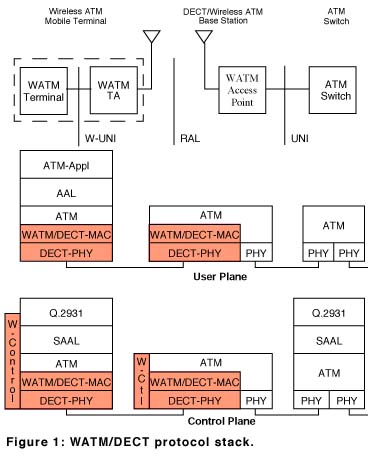
In the WATM prototype the access to the TDMA physical layer is achieved by means of a WATM/DECT Media Access Control (MAC) layer developed for the prototype. Instead of allocating fixed parts of the available bandwidth for the duration of individual connections - as is done by the DECT higher layer protocols - the MAC layer of the prototype supports the flexible allocation of bandwidth for different ATM connections on the basis of a ‘request/grant’ protocol between the base station and the end systems. Using this MAC protocol, it is possible to re-distribute the actual available bandwidth every 10ms (which is the duration of a DECT time frame) on an on-demand basis.
The MAC protocol has been designed and implemented in order to support real-time and non-real-time voice/video and data services as defined by the ATM Forum. In the WATM/DECT prototype the protocol runs on a TMS320C40 processor with parts of the software realized within XilinX PFGA’s (Field Programmable Gate Arrays).
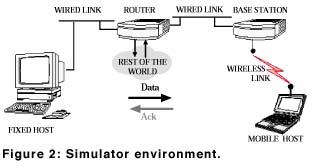
As far as the integration of the WATM technology into Internet is concerned CNUCE has developed a simulator of our environment to identify and eliminate sources of inefficiency. The environment under study is shown in Figure 1: a transmitter (the fixed host) sends data to a receiver (the mobile host) via Internet. The data transmitted by the fixed host cross the fixed network and arrive at the base station, and from there they are sent to the mobile host via a wireless connection. The TCP connections are modelled faithfully on the TCP protocol in accordance with the specifications of the RFCs and, where such specifications depend on the implementation, reference is made to the TCP/IP version supplied by Berkeley: 4.4 BSD-Lite. We also modelled the new protocol mechanism included in TCP Thaoe, Reno, SACK and New Reno.
Our simulator was used for an extensive performance evaluation of the TCP/WATM environment. The target of our analysis on TCP throughput was twofold: i) a study of the impact of user mobility, and, ii) a study of the impact of wireless links transmission error rates.
Results obtained so far have shown that the extension of the TCP protocols to support nomadic computing are far from being optimal. We are currently investigating the use of a mechanism to split the TCP Connection (ie, Indirect TCP techniques) in order to prevent the wireless link from introducing severe throughput limitations.
Please contact:
Enrico Gregori - CNUCE-CNR
Tel.: +39 050 59 32 50
E-mail: e.gregori@cnuce.cnr.it
Thomas Luckenbach - GMD
Tel.: +49 30 3463 7245
E-mail: luckenbach@fokus.gmd.de