

ERCIM News No.37 - April 1999
ERCIM News No.37 - April 1999
Mathematical Morphology and Image Processing
by Henk Heijmans
In the processing and analysis of images it is important to be able to extract features, describe shapes and recognize patterns. Such tasks refer to geometrical concepts such as size, shape, and orientation. Mathematical morphology uses concepts from set theory, geometry and topology to analyze geometrical structures in an image. A substantial part of CWI’s research theme Signals and Images is connected with multiresolution methods, based on the application of fractals, wavelets and morphology. One line of research explores the relationships between wavelets and morphological methods, aiming at a unified approach.
The word ‘morphology’? stems from the Greek words morfh and logos, meaning ‘the study of forms’. The term is encountered in a number of scientific disciplines including biology and geography. In the context of image processing it is the name of a specific methodology designed for the analysis of the geometrical structure in an image. Mathematical morphology was invented in the early 1960s by Georges Matheron and Jean Serra who worked on the automatic analysis of images occurring in mineralogy and petrography. Meanwhile the method has found applications also in several other fields, including medical diagnostics, histology, industrial inspection, computer vision, and character recognition.
Mathematical morphology examines the geometrical structure of an image by probing it with small patterns, called ‘structuring elements’, of varying size and shape, just the way a blind man explores the world with his fingers or a stick. This procedure results in nonlinear image operators which are well-suited to exploring geometrical and topological structures. A succession of such operators is applied to an image in order to make certain features apparent, distinguishing meaningful information from irrelevant distortions, by reducing it to a sort of caricature (skeletonization). For example, in optical character recognition one may transform the digital image of a symbol by reducing each connected component to a one-pixel-thick skeleton retaining the symbol’s shape. Such a skeleton suffices for recognition and can be handled much more economically than the full symbol.
Experience in image processing and computer vision has shown that for a comprehensive understanding of a scene analysis at a broad range of resolution levels is necessary. The resulting multiresolution techniques (quadtrees, pyramids, fractal imaging, scale-spaces, etc.) all have their merits and limitations. For example, fractals have been exploited with great success in image compression but to a much lesser extent for segmentation problems.
In the earliest multiresolution approaches to signal and image processing, the most popular way was to obtain a coarse level signal by subsampling a fine resolution signal, after linear smoothing, in order to remove high frequencies. A ‘detail pyramid’ can then be derived by subtracting from each level an interpolated version of the next coarser level. From a frequency point of view, the resulting difference signals (known as detail signals) form a signal decomposition in terms of bandpass-filtered copies of the original signal. There is neurophysiological evidence that the human visual system indeed uses a similar kind of decomposition. This tool has been one of the most popular multiresolution schemes used in image processing and computer vision. CWI is currently investigating a general axiomatic pyramid scheme encompassing most existing linear as well as nonlinear (morphological) pyramids.
The emergence of wavelet techniques has considerably boosted the multiresolution approach. Unfortunately, application of wavelets to problems in image processing and computer vision is sometimes hindered by its linearity. Coarsening an image by means of linear operators may not be compatible with a natural coarsening of some image attribute of interest (shape of object, for example), and hence use of linear procedures may be inconsistent in such applications.
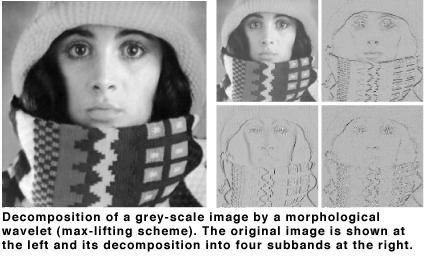
Mathematical morphology (nonlinear) is complementary to wavelets (linear) in that it considers images as geometrical objects rather than as elements of a linear (Hilbert) space. Many of the existing morphological techniques, such as granulometries, skeletons, and alternating sequential filters, are essentially multiresolution techniques. Bearing this in mind, one may wonder what are the relationships between the existing linear (wavelets) and nonlinear (morphological) multiresolution approaches. Is it possible to unify both approaches into one mathematical framework? Does there exist such a thing as a ‘morphological wavelet’? The somewhat ambitious goal of CWI’s research effort is to answer such questions. First promising steps have been made by the author in collaboration with J. Goutsias (Johns Hopkins University).
Please contact:
Henk Heijmans - CWI
Tel: +31 20 592 4057
E-mail: Henk.Heijmans@cwi.nl