

ERCIM News No.37 - April 1999
ERCIM News No.37 - April 1999
Introducing Intermodality for Social Tools
by Kent Saxin Hammarström and Kristina Höök
The Convene project at the Swedish Institute of Computer Science deals with improving the interface to text-based virtual environments (MUD’s), used for recreational and social purposes, for users with disablements (a group that constitutes 10-20% of the world population). These systems are potentially useful ‘social tools’ for those restricted from full participation in social relationships and leisure, but have received little attention in terms of how to make them more accessible.
MUD’s are a type of networked systems, primarily used for recreational purposes, such as games and social interaction, since the early 80’s. What distinguishes them from other forms of computer mediated communication is that they involve real-time interaction between multiple users and between users and a virtual world.
MUD systems could be excellent social tools for users with certain forms of disablements that would open up both an accessible form of recreation and a social venue with lower barriers to interacting with others.
The aim of the project is to see what problems - if any - users with disablements experience in these environments and how these could be alleviated. Our two studies done so far (one with a group of users with muscle dystrophy and one of blind users) indicate that one of the major, software-related problems is not qualitatively different from that of any user: information overload. This manifests itself in problems with navigation in the MUD worlds, problems with keeping the pace of the quite fast interaction between users, and finally, problems with the actual contents and social behaviours in these environments. We would like to point out that we are all experiencing these problems to some degree; activity limitations (disabilities) simply exacerbate this.
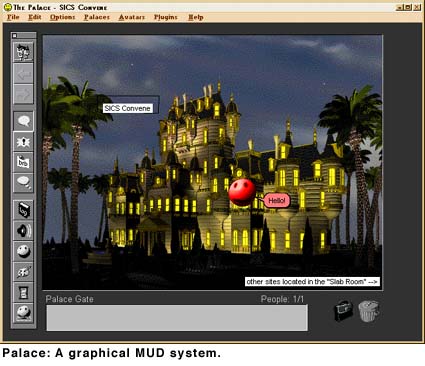
We have chosen to use multimodality as the main thrust of how to improve these interfaces, in the form that we call ‘intermodality’, ie designing a modular software architecture that facilitates translating information from one representation (initially primarily textual) to one more suited to the user and the situation. We take textual input from the MUD world, such as, rooms descriptions, dialogues between users, events in the world, etc., and divide it into different channels: the room description channel, the dialogue channel, etc. The user can then choose which channel to present as audio, text, pictures, etc. For example, the room descriptions might be sent to the user as text, the dialogue with other users might be presented as speech output, and the structure of the world (which ‘doors’ a room contains) can be showns as a ‘map’. Our fundamental vision is to solve the problem that it is the producer rather than the consumer determines the form of information - through dividing the information into different channels and allowing users to set these up as they please, the control is handed back to the consumer. This approach has two facets:
- allowing compensation for functional impairments
- reducing the cognitive load by allowing the user to have information presented in complementary channels (eg utterances from other participants through speech synthesis and descriptions through a Braille display).
The project has a practical and problem-oriented, rather than technology-oriented, focus: Can we design a software architecture that allows creating programs that make existing MUD systems more accessible, without requiring additional, expensive equipment, using the resources the user would normally have at her disposal? The actual networking technologies used are thus the ‘tried and true’ in the form of existing MUD environments (predominantly using TCP/IP and Telnet over the Internet) rather than innovative ones, and the focus is on improving the software user interface to these technologies.
In summary, Convene aims to put the control over the form of information into the hands of the (disabled) users in order to enable them to access existing textual MUD environments.This project is financed by the Swedish Institute of Computer Science (SICS), The Swedish Transport and Communications Research Board (KFB), and The Swedish National Board for Industrial and Technical Development (NUTEK). The Swedish Handicap Institute (HI) and the Swedish National Association for Disabled Children and Young People (RBU) contribute as advisors.
More information about the project can be found at:
http://www.sics.se/~kia/convene/
Please contact:
Kent Saxin Hammarström - SICS
E-mail: kent@sics.se
Tel: +46 18 471 7041