

ERCIM News No.37 - April 1999
ERCIM News No.37 - April 1999
HOT - Home and Office Technologies
by Thomas Luckenbach
The realization of networks for the interconnection of sub-computer devices like light switches, sensors or actors can be done by means of a variety of networking technologies. The article will give an overview about some of these technologies for the SOHO (Small Office Home Office) market which are currently being studied in the I3C (Integration of Infra-/Intra-/Internet Communications) project at GMD Institute for Open Communication Systems.
The area of microelectronics is one of the fastest developing technical areas in the world. Microelectronics together with modern software technologies will become one of the driving forces behind the envisaged age of the information and knowledge society.
While there are ‘only’ about 200 million personal computers worldwide there are already about 12 billion microcontrollers installed within nearly all kind of electronic equipment. In the home and office environment these microcontrollers can be found within stoves, washers and dish washers, coffee maschines, refrigirators, TV-sets/VCR’s, video beamers, etc.
The interconnection of these devices by means of suitable network technologies will lead to a new type of networks termed ‘Infranetworks’. These Infranetworks can be used for a variety of applications and services like facility management systems for home and office automation, theft and security control or personalized environments/person and location aware systems based on active badges and suitable sensors within the Infranet.
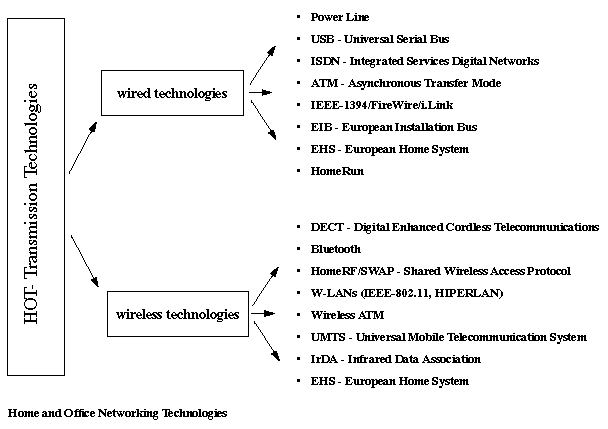
The realization of these Infranetworks can be done by means of different networking technologies, which can be classified into wired and wireless Infranet technologies (see figure).
Wired Technologies
Power line systems are using the existing inhouse cabling installed for power distribution for the exchange of control information with a maximum bandwidth of a few Kbit/s. The Universal Serial Bus is designed for the interconnection of low bandwidth devices like keyboard, mouse, joystick or low resolution cameras. It operates over distances of up to 5 meter with a total bandwidth of 12Mbit/s.
IEEE-1394 is designed to interconnect high-end digital audio/video equipment like camcorders, digital VCR’s or video printers as well as to interconnect personal computers (1394 home PC network). It supports data rates of up to 400Mbit/s at a distance of up to 4.5 meters. The predecessor of 1394 is FireWire, an initiative by Apple Comp. while Sony has started a branding initiative for 1394, called i.Link.
The European Installation Bus EIB is a free topology, decentralized system for home and building automation. It is based on a CSMA/CA technique via a 4-wire bus and provides 2.4Kbit/s bandwidth.
The European Home System EHS is designed as a ‘home communication system’ supporting different physical media like power line, coax, twisted pair and wireless infra-red. Most of the current systems are based on power line with 2.4Kbit/s.
HomeRun is currently being developed with the goal of providing a simple, high-speed Ethernet technology for the home environment based on existing telephone wires. It is initially planned for 1Mbit/s with upgrade plans to 10Mbit/s and beyond and operates at distances of up to 150m.
The Local Operating Network (LON) is mainly based on the LonTalk communication protocol and the Neuron-Chip. LON currently supports different media like twisted pair, free topology networks, power line and network interfaces like PC cards.
Wireless Technologies
The DECT standard (Digital European Cordless Telecommunication Systems) has been developed by ETSI (European Telecommunication Standards Institute) for in-building voice communications. It operates around 1.9 MHz with a total bandwidth of 1.152 Mbit/s (2 Mbit/s option available) and allows distances of up to 300m between end systems and base station.
The Bluetooth proposal is targeted towards ‘a global specification for Wireless Connectivity’ and will operate initially with a bandwidth of 1Mb/s in the 2.4GHz ISM band.
The Shared Wireless Access Protocol by the HomeRF working group is based on a combination of DECT and W-LAN (802.11) technologies. It uses Time Division Multiple Access (TDMA) and Carrier Sense Multiple Access/Collision Avoidance (CSMA/CA) in the 2.4GHz band and provides 1Mbit/s or 2Mbit/s depending on the modulation scheme.
The IrDA (Infrared Data Association) specifications currently include protocols for point-to-point as well as multipoint data transfer via short distances (<10m) with 115Kbit/s, 4Mbit/s and even 16Mbit/s.
Conclusion
I3C is a project running since the beginning of 1998 at GMD Institute for Open Communication Systems. The goal of the I3C project is the provision of a seamless networking infrastructure as a basis for a ubiquitous communication environment. In order to reach that goal current activities concentrate on the integration of LON (Local Operating Network), power line, IrDA, Inhouse ISDN (Integrated Services Digital Network), Ethernet, ATM (Asynchronous Transfer Mode) and ADSL (Asymetric Digital Subscriber Line). First results indicate the suitability of standard Web-browsers to monitor and control Infranet devices via the Internet. \Please contact:
Thomas Luckenbach - GMD
Tel: +49 30 3463 7245
E-mail: luckenbach@fokus.gmd.de