

ERCIM News No.37 - April 1999
ERCIM News No.37 - April 1999
Integration of Multiple Switching Disciplines
by Pertti Raatikainen
Multimedia services presume that the underlying transport network supports a large variety of connections and guarantees required quality of service. A number of networking concepts has been tested, but none of them has gained ultimate acceptance. ATM technology has been the most favoured one, but other transporting solutions have also been considered and entirely new ones suggested, especially, for IP based communications.
Development of a new unifying transport concept is a long process, and it can be envisaged that heterogeneous transport solutions will be used for multimedia service delivery for a lengthy period of transition. This implies that future network nodes, such as switches, have to interface to different kinds of networks, manage a number of parallel call control procedures and support switching of dissimilar data units.
As a solution to the emerging problem, VTT Information Technology and Helsinki University of Technology have launched SCOMS (Software Configurable Multidiscipline Switch) project to develop a switching and routing solution capable of supporting multiple switching disciplines. The target is to develop a network node that integrates circuit, cell and packet switching into a single fabric. The project is funded by TEKES (Technology Development Centre of Finland) and six industrial partners. The project was started early 1998 and finishes by the end of year 2000.
Experimental Switch
A conventional telecommunications switch connects to a homogeneous transport network whereas a multi-discipline switch operates in a heterogeneous networking environment, ie, networks that utilise different transport technologies. Due to the different nature of the associated transport technologies, the switching equipment has to implement a set of different line interfaces and signalling procedures and, additionally, to support a varying set of connection types, quality of service measures and service types.
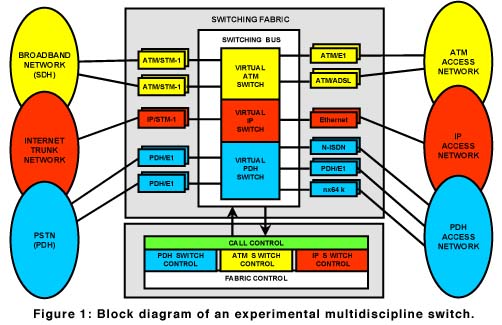
A straightforward way to implement such a switch is to logically divide the switch into separate ‘virtual switches’. In this way, line cards, protocol stacks and associated call control functions of each virtual switch can work as if they were run in a homogeneous network. At the bottom layer, a common control block is needed to manage resources of the physical switch (eg switch configuration), convert application level connection commands to physical connections and perform physical level routing of the by-passing data units.
The concrete goal of the SCOMS project is to develop an experimental switch integrating 64 kbit/s based circuit, ATM cell and IP packet switching (see Fig. 1). The physical switching platform is based on the Frame Synchronised Ring (FSR) concept, developed and patented by VTT Information Technology. This platform has characteristics necessary to implement the various fundamental features of a multidiscipline switch. These include, eg, inherent support for real-time multicasting, versatile addressing capabilities and support for simultaneous switching of different size data units. FSR’s ring-shaped switching bus is dimensioned to perform effectively by implementing separate transport containers for circuit, cell and packet switched traffic.
Operation of the switching fabric is controlled by a workstation which implements fabric and call control functions. Signalling protocols of the three different transport networks (ATM, PDH and IP) are implemented separately, although, they use services of the common fabric control layer (see figure 2). Interworking between the different networks can be supported by a shared interworking call control module that is able to manage calls that originate and terminate at different networks (see figure 3).
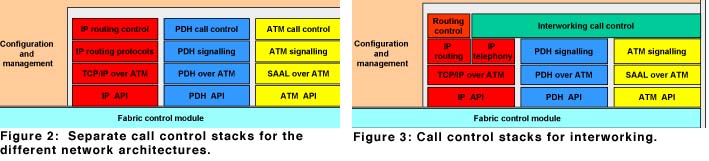
The switch control module offers network specific application programming interfaces that implement functions necessary to reserve resources and manage connections through the switch. The control workstation is connected to the switch with an ATM/STM-1 link, and all protocols receive and transmit their signalling messages in reserved ATM virtual channels. Therefore, a non-ATM line interface must map the incoming signalling messages to a specific ATM virtual channel, assigned for transferring the signalling to the control workstation. ATM/STM-1 was chosen for the workstation connection, because it is a cost-effective way to have a high-speed signalling link, which offers a straightforward way to manage various control and signalling connections. An Ethernet interface is another possibility to connect the workstation to the switch.
The above configuration can be enhanced by introducing an interworking call model to route calls between the different networks (Fig. 3). In this configuration, the different protocol stacks are linked together via a shared call control layer. The call control must be able to decode, process and forward connection set-up requests from each protocol stack. The call control interworking function maps the connection set-up parameters between the different networks and maintains status information of all the established connections.
Currently, the SCOMS switch and its control architecture is in the implementation phase, and the first prototype, offering interworking between ATM and PDH networks, is expected by the end of year 1999. Further work will include interworking with IP networks, service architecture considerations as well as development of configuration and management applications. The inherent support for TCP/IP networking enables interesting views, for example, to develop distributed service control and web-based management.
Please contact:
Pertti Raatikainen - VTT Information Technology
Tel: +358 9 456 5644
E-mail: pertti.raatikainen@vtt.fi