

ERCIM News No.37 - April 1999
ERCIM News No.37 - April 1999
Technology Interoperation in ATM Management
by Stelios Sartzetakis
Providing cost-effective network survivability and availability; fast-responding, reliable fault detection and self-healing mechanisms, distributed dynamic routing functions with inherent load balancing capabilities, efficient VP layer design and dynamic network reconfiguration functions in an ATM network is a complicated task. Emerging technologies and standards are needed for the operation and management of ATM networks. The ACTS REFORM project used a number of these including: ATMF UNI and PNNI, OMG CORBA and Component Model and TINA NRA thus demonstrating the applicability, coexistence and interoperation of some of these technologies.
Having the network provider’s viewpoint in mind, who is offering QoS-based, switched, on-demand connectivity services, the REFORM project designed, implemented and tested a prototype system which provides the necessary means and functions for ensuring network resilience (availability & survivability) within acceptable levels, and in a cost effective manner. The REFORM system covers the configuration, performance and fault management functional areas. REFORM’s control plane system (embedded in the network elements) hosts the required connection-oriented network layer functionality in addition to the REFORM-specific fast-responding fault detection, self-healing and QoS-based dynamic routing functions. The management plane system is concerned with the initial configuration and on-going dynamic management of the ATM VP layer. Specifically it hosts dynamic VPC bandwidth management, VP layer design and dynamic reconfiguration, fault management (filtering and correlation) functions as well as generic configuration and network resource monitoring functions.
The entire REFORM system operates through a hierarchical model at different levels of time-scale and abstraction. The REFORM management system integrates the tasks of network planning and dimensioning with dynamic configuration, fault and performance management. The network planning and dimension functions lie at the heart of the REFORM system facilitating cost-effective network operation and enabling the implementation of the operator’s business policy regarding service provisioning for the range of services being offered. Dynamic configuration, fault, and performance management are required for continuously optimising the performance of the network according to actual usage levels. Traditionally, these areas have been handled by disjoint systems for network planning, configuration management, performance management and fault management.
In our view, network management is much more than a data collection exercise for supporting configuration, fault and performance reports to be subsequently fed to network operators to determine the next course of action. REFORM considers network management functions as built-in, automated and intelligent facilities, which respond to changes in network conditions as and even before they happen. A human-orientated model of decision making may no longer be always viable for ensuring the cost-effective management of complex, multi-service networks. Network management functions need to actively interact with the network, exploiting and complementing the capabilities of the Network Elements (NEs), and therefore should be seen as an extension of embedded NE functionality.
REFORM used networks built from multi-vendor NEs in its trials. As of today, implementations of the same signalling protocol by different vendors rarely fully inter-work and co-operate. Furthermore, the other REFORM control plane components were required to co-operate with the signalling components for collecting statistics and providing routing information. This level of interaction with embedded capabilities is not feasible with today?s commercially available NEs, as access to the internal functionality of the network equipment is very limited. To overcome these problems, the notion of the REFORM Node was introduced. The REFORM Node incorporates the control plane functions of the REFORM system, allowing vendor-independent interaction with the NEs and uniform signalling and routing functions throughout the network. This is achieved by isolating vendor-specific technology from the system components through an intermediate adaptation layer to the specific NE. An existing ATM Forum UNI 3.0 signalling stack implementation was modified in order to offer uniform signalling capabilities at both UNI and NNI reference points of the REFORM Node. However it should be noted that any NNI protocol eg B-ISUP, PNNI could have been used. Appropriate modifications according to the REFORM model for QoS provisioning had to be made.
The PNNI specification can be seen as containing two parts: the routing protocol and the signalling protocol. The PNNI routing protocol was used as the basis for dynamic routing in REFORM. The REFORM QoS-based routing algorithm runs over the PNNI topology information distribution mechanisms. The PNNI routing protocol specifications constitute a rich platform for building intelligent routing schemes. PNNI routing protocols may co-exist with other signalling systems, which support source node or hop-by-hop routing. However, some routing schemes, such as the one adopted by REFORM, may be of a hybrid nature combining the merits of centralised and distributed routing. The PNNI specifications should not be seen as dictating the particular routing scheme to be applied, but rather as a framework enabling distributed exchange of topology information.
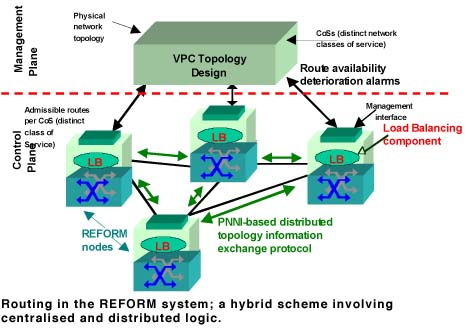
In the REFORM system, a hybrid routing scheme is adopted shown in the figure. The centralised part (residing in the management plane) defines the admissible routes per source-destination and CoS (distinct Class of Service) so that the QoS requirements of the CoSs and certain network-wide cost-effective criteria are met. The distributed part is responsible for influencing the routing decisions (from the many possible pre-defined admissible routes), according to actual traffic conditions, with the purpose to drive the network towards a load-balanced state. This hybrid routing scheme maintains the merits of dynamic routing and at the same time harnesses routing dynamicity to operate within the overall network operational policies with respect to QoS provisioning. Experimen-tation has shown that the distributed PNNI routing protocols can interoperate with overlying network management systems for QoS-based routing.
CORBA was used as the ultimate integration means that allows transparent communication not only between distributed objects, but also between objects located in the same machine; eg between two components in the same network node. In the same way that CORBA insulates distributed applications from network details it also abstracts implementations from operating system peculiarities. We are in no doubt that future management frameworks will be based on distributed object technologies, with CORBA being a prime candidate. It is also likely that CORBA can be used in the control plane to support open, object-oriented network layer functionality, though this requires lightweight operations and mappings of its protocols over specific network technologies such as ATM AAL5. The use of the OMG Component Model in the REFORM control plane was a step in this direction.
The REFORM system is one of the first attempts to validate the TINA NRA (Telecommunications Information Networking Architecture Network Resource Architecture) in a practical network management application encompassing configuration, performance and fault management aspects. REFORM field trials were conducted on several testbeds: the ACTS EXPERT testbed in Basel, Switzerland, and on ATM networks in Norway, Greece and Japan.
The REFORM system realisation showed that the evolution towards flexible telecommunications systems built from off-the-shelf intelligent software and hardware components is feasible in the near future. The project REFORM was part of the ACTS programme. The other partners were NTT, Telenor, OTE, Alcatel, UCL, NTUA, Skelton, IONA, with Algosystems as the co-ordinator. Further information can be found at: http://olympus.algo.com.gr/acts/reform/public.htm
Please contact:
Stelios Sartzetakis - ICS-FORTH
Tel: +30 81 39 1727
E-mail: stelios@ics.forth.gr