

ERCIM News No.37 - April 1999
ERCIM News No.37 - April 1999
The New CNR Research Area in Pisa chooses an ATM Local Area Network
by Marco Sommani
Starting in late spring of 1999, the 15 CNR institutes in Pisa will move to a new campus, known as the ‘Area della Ricerca di San Cataldo’. The backbone of the local area network of the new campus has been designed using ATM LAN Emulation (LANE) and Multiprotocol over ATM (MPOA). The benefits of an ATM based solution appeared clear as recently as two years ago. Now, however, with the appearance on the market of powerful layer-3 switches with gigabit Ethernet interfaces, the advantages of ATM based LANs have become much less evident, to the point that their deployment is discouraged by many experts. This article claims that, even if layer-3 switching techniques over gigabit Ethernet can minimise the price/throughput ratio, an ATM-based LAN remains the best solution if multiple broadcast domains are scattered over the same physical infrastructure.
Design Goals and Constraints
Currently the 15 CNR institutes in Pisa are scattered throughout the city. Typically, each institute has its own internal LAN and communicates with the rest of the world via a slow connection (64 Kb/s or basic rate ISDN in most cases, with a few 2 Mb/s exceptions). The router with the external Internet connection is located in a block hosting four institutes: CNUCE, IAT, IEI and IMC. The internal WAN topology is roughly a star centred at the site with the Internet connection.
Inter-institute traffic is quite low. Most communications are either internal within an institute or directed to remote Internet destinations. Only IP is used for inter-institute traffic. Intra-institute traffic is also based on other protocols, most commonly AppleTalk, IPX and NETBEUI.
The LAN of the new campus must be able to meet two conflicting requirements: it must keep a clear separation between the broadcast domains of different institutes and enable high-bandwidth and low-delay inter-institute communications. This is because (i) it has been considered undesirable to force network users to change their habits suddenly, and (ii) inter-institute co-operation is expected to become increasingly important and some institutes may be requested to host servers providing services to the whole campus.
The Solution
A graphical description of the new LAN is available at http://soi.cnr.it/~mario/ piante/Default.html.
The figure gives a simplified schema representing the fibre connections between wiring closets. The four big rectangles represent the main buildings in the campus (A, B1, B2 and C). Smaller rectangles represent the 27 wiring closets concentrating all copper cable coming from the rooms.
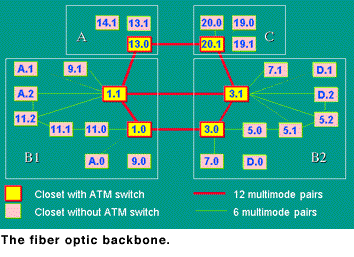
The ATM switches (IBM 8260s) are located in the wiring closets of the central hexagon (1.1 - 1.0 - 3.0 - 3.1 - 20.1 - 13.0). LAN emulation, MPOA, routing and bridging services are provided by equipment (IBM MSS) co-located with two ATM switches. All other wiring closets are just one fibre hop away from the nearest ATM switch. Every wiring closet contains Ethernet switches (IBM 8271s) with fibre ATM uplinks to the nearest ATM switch. Fibre connections between peripheral wiring closets shown in the figure are currently not used.
Typically one institute spans from two to six wiring closets and shares some closets with other institutes. Ethernet ports on the Ethernet switches are statically assigned to broadcast domains; every broadcast domain is associated with an emulated LAN (ELAN) in the ATM cloud. The Ethernet switches now in place are not MPOA-capable. As a result, all traffic between different broadcast domains must transit through one of the two IBM MSS acting as a router, resulting in an obvious bottleneck for all inter-institute traffic. This will not be a real problem in the beginning, when inter-institute traffic is expected to remain low; however, as soon as inter-institute traffic starts to increase, it will become necessary to add MPOA-capable edge devices such as the IBM 8371 to the infrastructure.
Comparison with a Gigabit Ethernet Solution
The alternative to the ATM solution is to place layer-2 and/or layer-3 switches in every closet and to interconnect them via point-to-point Ethernet links at appropriate speeds (100 Mb/s or 1000 Mb/s).
The non-ATM solution is appropriate when there is a close correspondence between broadcast domains and the physical topology of the network. In all other cases, the answer in a non-ATM world is to use Virtual LANs (VLANs), ie to use bridging to exchange traffic between hosts of the same broadcast domain attached to different switches and to “tag” frames sent over inter-switch links with their VLAN identifier.
With complex VLAN topologies, management may be a real nightmare. In fact, if all inter-switch links are enabled for transporting traffic for all the VLANs, then all broadcasts and Multicasts of the VLANs are propagated to all switches; otherwise, if inter-switch links are configured just for those VLANs that they should interconnect, network management becomes too complex.
With complex VLAN topologies, it is also very difficult to configure inter-VLAN routing in a way that minimises the number of hops over inter-switch links. This problem is only partially reduced by special features that are common on many layer-3 switches, such as IP auto-learn.
Conclusions
When the LAN structure is simple, gigabit Ethernet and layer-3 switches can offer the best price/performance ratio. In all other cases, ATM LAN emulation, with its two-level addressing structure, provides a much better solution, because it optimises traffic patterns and simplifies network management.
In the last two years, there has been a tendency in the academic community to under-estimate the advantages that can be obtained with ATM. This probably depends on the fact that typically broadcast domains inside universities can easily be mapped over the physical infrastructure.
Strangely enough, ATM is also quite uncommon on commercial sites. A possible explanation is the fact that many network consultants prefer to promote what they already know (Ethernet) rather than spending time to learn something new (LAN emulation and MPOA).
If this trend continues, prices of Ethernet-based solutions will continue to fall and ATM prices will remain stable. Even worse, switch manufacturers might decide to stop investments in ATM products.
In order to stop this trend, every effort should be made to clarify ATM advantages to as wide an audience as possible.
Please contact:
Marco Sommani - IAT-CNR
Tel: +39 050 593 313
E-mail: Marco.Sommani@iat.cnr.it