

ERCIM News No.37 - April 1999
ERCIM News No.37 - April 1999
Gigabit Networking is Reality - 2.4 Gbps via ATM Wide Area Network
by Peter Wunderling and Ferdinand Hommes
One year after the successful start of the first German Gigabit Network Testbed (see ERCIM News Number 31, October 1997) the participants of the ?Gigabit Testbed West” could demonstrate transmission speeds of 2.4 Gbps using ATM technology (Asynchronous Transfer Mode). The project is sponsored by the German Research Network Association ‘Verein zur Förderung eines Deutschen Forschungsnetzes, e.V, (DFN)’, and the Federal Ministry for Education, Science, Research and Technology of Germany with additional funding of the participants GMD and the Research Center Jülich (Forschungs-zentrum Jülich - FZJ).
The goal of the testbed is to get experiences in high speed networking and to show the necessity for next generation applications. Experiences and knowledge of the testbeds are base of the design and operation of the next generation network for the scientific community in Germany which is planned by DFN. The focus of the testbed is on metacomputing as well as on dedicated multimedia applications like ‘Distributed virtual studio applications’. In this article only the networking aspects are shown.
The Gigabit Testbed West is one of two Gigabit Testbeds in Germany (the other one is Gigabit Testbed Süd) and started at August 1st 1997 with a 622 Mbps link between both research centers. The technique is Asynchronous Tranfer Mode via SDH (Synchronous Data Hierarchy). The SDH equipment and the fiber optic link (about 100 km between the locations Sankt Augustin and Jülich) are provided by o.tel.o Service GmbH, a subsidiary company of a German energy supplier.
In the first step ASX-1000 switches (FORE Systems) connected the local ATM networks of both research centers running the link with 622 Mbps. The high performance computing (HPC) systems on both sides (CRAY T3E with 512 nodes in Jülich and IBM SP2 with 34 nodes at GMD) were connected to the ATM network via 155 Mbps interfaces. The first tests and measurements of the throughput between the HPC systems were disappointing - far below of 155 Mbps.
Since the announced 622 Mbps ports (ATM) for both systems are up to now not available, the following solution was implemented to connect the CRAY T3E with the IBM SP2: FZJ and GMD are running HIPPI (High Performance Parallel Interface) to connect their HPC systems with transmission speeds of up to 800 Mbps. Using SUN and SGI systems with one or more 622 Mbps ports for the ATM network and interfaces for the HIPPI network it was possible to run these systems as HIPPI/ATM gateways.
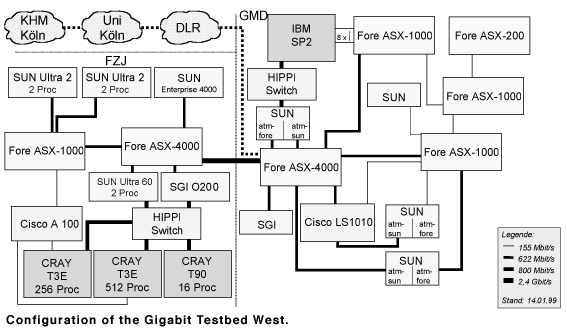
The great success was at August 5th 1998. Both research centers could demonstrate the first 2.4 Gbps ATM WAN in Europe. Running ASX-4000 (the newest generation ATM switches of FORE Systems) with 2.4 Gbps interfaces on both sides the theoretical throughput of 2,17 Gbps for ATM data (in total: 2.488 Gbps capacity minus overhead for SDH and ATM) could nearly be reached. The tremendous data traffic was generated by several SUN systems each of them connected to the ASX-4000 with one or more 622 Mbps interfaces (SUN and FORE Systems).
The performance measurements of the ATM/HIPPI gateways showed acceptable results: 430 Mbps between CRAY T3E and H/A-gateway and 370 Mbps between IBM SP2 and H/A-gateway. Between the gateways a maximum throughput of 500 Mbps was measured. That means up to now both HPC systems can communicate with a maximum throughput of 370 Mbps.
The next steps in the Gigabit Testbed West are to get the link to Cologne operational and to implement the planned applications like ‘Distributed TV-Productions’ and ‘3V - Distributed Traffic Simulation and Visualization’.
Fore more information, see: http://imk.gmd.de/hsn/
Please contact:
Peter Wunderling - GMD
Tel: +49 2241 14 2930
E-mail: peter.wunderling@gmd.de
Ferdinand Hommes - GMD
Tel: +49 2241 14 2932
E-mail: ferdinand.hommes@gmd.de