Multilevel Forecasting improves Corporate Planning and Operations
by Ilkka Karanta
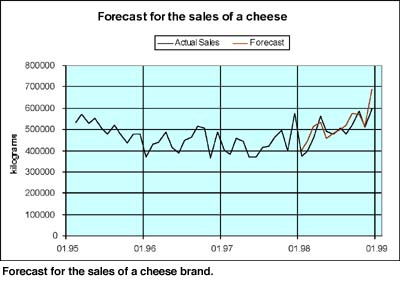
Forecasting involves estimating future values for a process that is at least partially uncontrollable. Examples range from weather to election results and stock prices. An important subfield of forecasting is sales forecasting, where one tries to forecast the sales of products usually targeted to the consumer market. Although different actors in the supply chain -producers, wholesale companies and retail companies - all have ways of affecting the sales such as marketing and pricing, important uncertainty factors remain due to eg consumer behavior and the actions of competitors.
Forecasts are needed on all levels of supply chain planning. At the operational level, logistical decisions such as inventory levels and transportation schedules and routes are affected by sales forecasts. At the tactical level, yearly budgeting decisions are affected by estimated sales for the next year. And at the strategic level, investment decisions are affected by estimates of regional demand for products.
A pervasive feature of sales forecasting problems is that they are needed for different hierarchies, and at different level in these hierarchies. For example, product-level forecasts are needed by marketing; product-group level forecasts are needed in budgeting; forecasts by region and product are needed in logistical decisions; and forecasts by customer and product are needed by customer-relations management staff. On the other hand, forecasts are needed for different time spans (a year, a quarter, or a month) and for different sample rates (monthly, weekly or daily data). These forecasts should be consistent, and, in the best case, the models and data for each process should support the accuracy of forecasting in all the processes.
VTT Information Technology is doing research on automated modeling and hierarchical forecasting. In automated modeling, the emphasis is on selecting both an appropriate model class for a forecasting task (such as ARIMA, regression, exponential smoothing or neural networks) and an optimal model structure within that class. In hierarchical forecasting, the emphasis is in coordinating different models for different hierarchy levels so that forecasts are consistent and accuracy is improved. On the other hand, also new product forecasting, and the effects of new and ending products and customers on the items in hierarchies have been stresspoints of the research.
As a result, a forecasting system is under development where forecasts for different levels in hierarchies and different sample rates can be made. Some highlights of the system:
- multiple hierarchies are supported: the user can define for which nodes or levels the forecasts are needed in different hierarchies (eg product hierarchy, customer hierarchy, region hierarchy), and the forecasts at different levels are consistent with each other
- formulation of statistical models is automatic; the end user doesn’t need to know anything about statistical models
- several classes of statistical models are supported, and adding new classes is simple
- external software components are used in model parameter estimation and some other statistical calculations
- the system is platform-independent
- the system is object-oriented and written in Java.
The system has been installed to a large Finnish company in food manufacturing industry, and planning is under way to an implementation for a large Finnish wholesales company. Future plans include utilization of data in the whole supply chain, and the incorporation of subjective assessment as part of the forecasting process.
Please contact:
Ilkka Karanta - VTT Information Technology
Tel: +358 9 456 4509
E-mail: Ilkka.Karanta@vtt.fi